Author name: AlexeyK

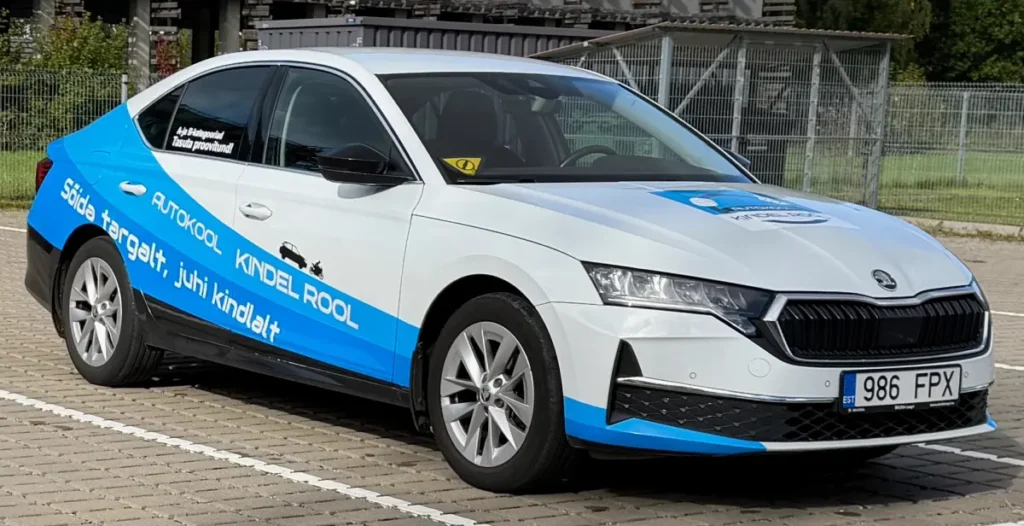
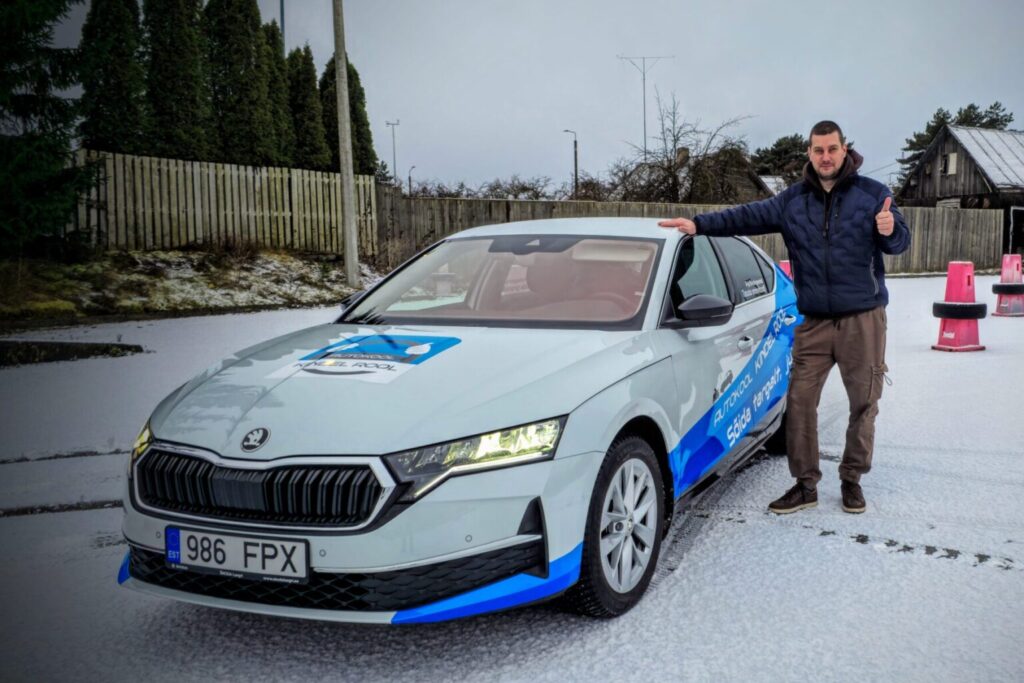
Autokool Kindel Rooli õppesõiduauto Skoda Octavia Tallinnas

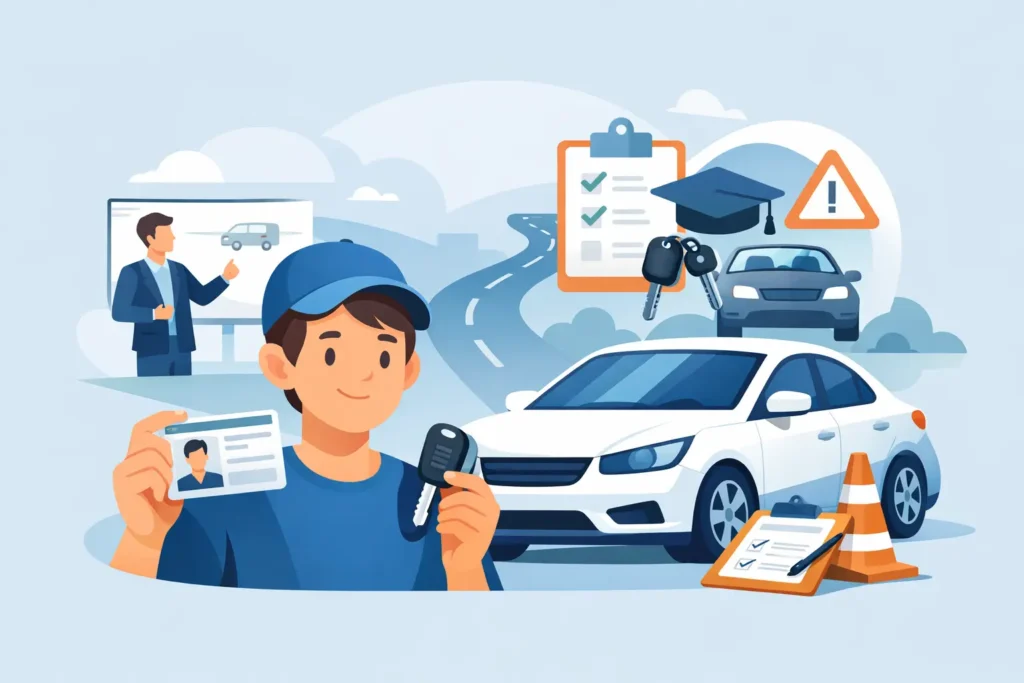
Booking your driving test: how to register and find a slot

Booking the slot itself is simple. What usually holds people up is one unmet condition further back in the chain. Here is the whole route from start to finish, including the two places where people lose money.
Who is admitted to the test: four conditions

Transpordiamet admits a person to the driving test who has:

  • completed the driver training course (initial or supplementary training, and continued training where required);
  • passed the traffic theory test;
  • paid the state fee;
  • brought a valid identity document.

The order matters here, and the first condition means more than it appears to. Completing the training course is not the same as having attended the lessons: the school can mark the course complete only once you have passed the driving exam the school itself runs. Until that is done, no slot for the state test can be booked. The theory test must be passed as well, and the fee paid.

The state fee for the category B driving test is 50 €. All the amounts are gathered on the state fees page.

Three ways to book a slot

  • In the Transpordiamet e-service, the quickest route and open around the clock. The category B driving test is booked here.
  • In person at a service bureau.
  • Through your driving school, if you have authorised it to act for you.

Step by step in the e-service

  • Open the Transpordiamet e-service.
  • Log in with an ID card, Mobile-ID or Smart-ID. You can also log in through your bank: Swedbank, SEB, LHV, Coop or Luminor.
  • Choose Driver from the menu. Everything to do with licences and tests sits there.
  • Choose driving test registration, then the category, the bureau and a slot that suits you.
The e-service also runs in English and Russian; the language switch is at the top of the page.

You can sit the test at any service bureau

Most learners do not know this, and it is exactly what solves the problem of a long queue.

“An applicant for the right to drive is permitted to sit the driving test at all Transpordiamet service bureaus, regardless of where the candidate lives or where the training provider is located.”

In practice that means this: if the nearest free slot in Tallinn is three weeks away, you do not have to wait for it. Check the slots at other bureaus too. Neither your place of residence nor the location of your driving school restricts the choice in any way. The list of bureaus and their contacts is on the Transpordiamet contacts page.

There is a consideration pulling the other way. You will not know the test route in advance in any case, not even in your own town, so that is not the difference. In an unfamiliar town the whole environment is new: the rhythm of the traffic, the look of the streets, junctions you have never seen. That adds tension, and tension is a risk of its own on a test. Decide which is harder for you: three weeks of waiting, or driving somewhere unfamiliar.

How long the wait is

No official waiting time is published, and that is not information being withheld: it depends on the bureau, the category and the season. The only reliable method is to look at the actual calendar in the e-service.

  • Check several bureaus at once, not only the closest one.
  • Slots also open up through cancellations, so it is worth looking again after a couple of days.
  • Book as soon as the school exam is passed, the theory test is passed and the fee is paid. Waiting does not make the queue shorter.

Changing and cancelling: where the money goes

If you cannot attend at the appointed time, you must notify the service bureau in writing at least three working days before the date set for the test. The time is then changed.

Notify later than that and the time is not changed. There is an exception: sudden illness, or another circumstance you could not influence or foresee, but you then have to submit appropriate evidence to the bureau.

The most expensive mistake: if you simply fail to turn up and have not given notice in time, the driving test is deemed to have taken place and the fee paid is deemed used. A fresh attempt means a fresh 50 euros.

What happens after the test

The examiner tells you the result immediately. The licence is issued within ten working days, counted from the day after you pass.

If you do not pass, booking a repeat slot is exactly the same procedure: a new fee and a new time. See also what to do after a fail. The whole process is gathered on the driving test hub.

Frequently asked questions

Can I book the driving test before the theory test?

No. A pass in the traffic theory test is one of the four conditions that must be met beforehand. The same goes for the training course: the school marks it complete only after its own driving exam.

Do I have to sit the test in the bureau where I live?

No. The test may be taken at all Transpordiamet service bureaus, regardless of your place of residence or where your driving school is.

What does the driving test cost?

The state fee for the category B driving test is 50 €. All the amounts are on the state fees page.

Does changing the time cost anything?

If you notify the bureau in writing at least three working days before the test, the time is changed. With later notice the time is not changed, other than in cases of documented sudden illness or another unforeseeable circumstance.

What happens if I simply do not turn up?

If you do not attend and have not given notice in time, the test is deemed to have taken place and the fee paid is deemed used.

How soon do I get the licence?

The licence is issued within ten working days, counted from the day after you pass the test.

Source: the Transpordiamet driving test page. Checked 21.08.2026.

Before the test

If the test is close and you do not feel ready, a few targeted lessons help more than a week of worrying. Look at the price of an extra driving lesson, or read what the examiner actually watches in the car.

FREE trial lesson
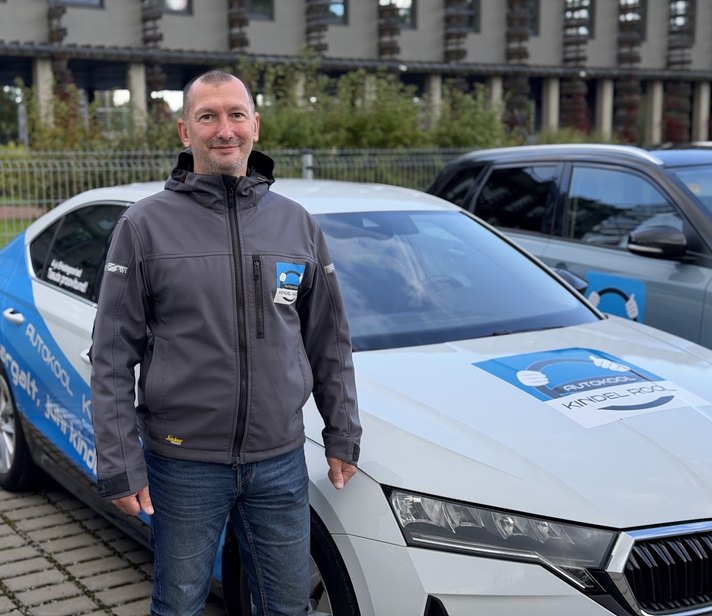
Sõiduõpetaja Igor Autokool Kindel Rooli õppesõiduauto kõrval Tallinnas

A former examiner on what is actually assessed during the driving test

Igor used to conduct driving tests himself, and joined the Autokool Kindel Rool team in the autumn. We asked him six questions about the things learners fear most, or get wrong. The answers are his.
The first two minutes in the car: what the examiner sees straight away

The test does not begin when the car starts moving. It begins with how you get in. The candidate settles in and prepares what Igor calls their workplace. The seat, the mirrors, the headrest and the steering wheel all have to be adjusted, every time.

“It cannot be that everything is already set up for you the moment you sit down. If a candidate does not do this and is ready to drive immediately, it means they are not quite ready to sit the test.”

What the examiner reads into it is that the person has not mastered this part of the job. And it is not a box-ticking formality: the same thing decides how safe the rest of the drive is.

This matters precisely because the test car may not be the one you trained in. What the car depends on is set out on the driving test hub.

Does one mistake end the test?

This is the fear most learners bring with them: make one mistake and you spend the rest of the drive going through the motions. According to Igor it does not work that way. The examiner does not stop the test on the spot, unless the situation is dangerous.

Creating a dangerous situation ends the test there and then, and there is no reason to keep driving for another twenty minutes. Nothing else is decided by a single mistake. What does count is repetition: a minor error that keeps coming back is a different matter altogether.

“There were cases where the test was passed after gross, serious mistakes, even though the examiner had already settled on a fail.”

The politeness that looks like not knowing

We asked what candidates do out of courtesy or fear that reads, from the passenger seat, as uncertainty. Igor named three things:

  • braking before junctions where there is no reason to;
  • giving way where they do not have to;
  • choosing the wrong speed.

The driver believes they are being careful. From the outside the impression is different: this person does not know who has priority. Giving way where it is not required is not courtesy, it is a sign that the rule has not been learned, and it gets in the way of everyone else.

The most common myth about examiners

What Igor hears most often from learners is that examiners are trying to fail them. The second common belief is that they are bad-tempered and rude.

“The test is a check of your practical skills and of your independence out on the road.”

Which also answers the question of how to prepare: not by memorising a route, but by being able to decide for yourself.

What separates someone who passes first time from someone on their third attempt

You would expect that by the third attempt a person has more practice behind them and is calmer. Igor says the opposite.

“Practically nothing. Many people drive worse on their third test and are more nervous than on the first.”

And one more thing worth knowing: the examiner does not know which attempt this is for you. Nobody gets into the car with an opinion already formed about your being there for the third time.

What to do in the hour before the test

Igor offers no trick here.

“Get a proper night of sleep. Take the test more lightly, however important passing is and however much depends on it.”

Which means the advice for the last hour really starts the evening before.

What to take from this:
  • Adjust the seat, mirrors, headrest and steering wheel, even when it all feels fine as it is.
  • One mistake is not the end of the test. A dangerous situation is.
  • Do not give way where the priority is yours.
  • The examiner does not know which attempt this is, and is not looking for a reason to fail you.

The interview was conducted in Russian; the quotations are translated.

Read next

Igor’s earlier advice, on memorising routes and the three most common mistakes, is in the guide to passing the test. Booking, state fees and how the test is run are gathered on the driving test hub.

FREE trial lesson
Mida kaasa võtta sõidueksamile? Kontrollnimekiri

What to bring to your driving test: a checklist

On the morning of your driving test, nobody wants to discover that a document was left at home, or that new, slippery shoes make the pedals hard to feel. The question of what to bring to your driving test is really part of good preparation. When the practical things are ready the evening before, you have more attention left on test day for what matters most: reading the traffic, making calm decisions and driving safely.

A driving test is not an attempt to impress the examiner. It is a chance to show that you can drive independently, attentively and with other road users in mind. A well planned test day reduces nerves, but it does not replace driving skill. So check both your documents and your own readiness at the same time. We cover how to pass the driving exam on the first attempt in a separate guide.

What to bring to your driving test: the checklist

The most important item is a valid identity document. Without it the examiner cannot verify who you are, and the test may not go ahead even if you are perfectly ready to drive. Put the document in a visible pocket of your wallet or bag the evening before, and do not rely on remembering it in the morning.

Before you leave for the test, run through this list:

  • a valid identity document, such as an ID card or passport;
  • glasses or contact lenses if you use them to correct your vision, plus lens solution or lubricating drops if you need them;
  • the time and place of your test booking, noted in your phone or on paper;
  • familiar shoes with a thin or moderate sole;
  • clothing suitable for the weather that does not restrict your movement;
  • a lighter jumper or vest, in case a thick winter coat gets in the way behind the wheel;
  • tissues or a small towel for drying wet soles;
  • the phone number of your driving school or instructor in case of an unexpected delay;
  • a small bottle of water;
  • your phone, with the sound switched off or set to silent before the test starts.

Booking confirmation is not always asked for separately, but it helps if you need to check the exact time, the meeting point or other practical details quickly. It is also worth making sure before test day that everything connected with the booking has been done. If something needs attention, such as the validity of your health certificate or your training records, it is far easier to sort out a couple of days ahead than on the morning of the test.

Do not compromise on glasses. If you see better behind the wheel with glasses or lenses, wear them for the test too. During the test you need to notice road signs, pedestrians, vehicles approaching from side roads and what is happening in the mirrors. Uncomfortable or unfamiliar vision correction takes attention away from exactly where it is needed most.

What you usually do not need to pack

Many learners worry about whether to bring their driving school certificate, a printout of the health certificate or other paperwork. In most cases the necessary training and health information moves digitally, and a separate folder of papers is not needed. That does not mean you can leave your records until the last minute, though.

If you have changed something recently, for example your name, a renewed document or a new health certificate, check in good time that the information is visible in the system. If any special arrangement applies to your test, follow the instructions in the booking first. When in doubt, resolve the question before test day rather than improvising on the spot.

Large bags, study materials and several pairs of shoes do not need to come along either. Too much stuff means more fuss and a better chance that something goes missing or gets in the way while you drive. The goal is to arrive ready, not to move half your life into the boot.

Clothing and shoes affect how the car feels

Your sense of style is not being assessed, but clothing directly affects how freely you can use the wheel, the gear lever and the pedals. Choose clean, comfortable, weather appropriate clothing that does not restrict your shoulders, hips or legs. If it is cold outside, you do not have to drive in a thick coat: it can shift the seat belt into an uncomfortable position and reduce the precision of your movements.

Shoes should sit firmly on your feet, have a thin or moderate sole and be ones you have driven in before. A very thick sole makes the clutch, brake and accelerator harder to judge. Slippery soles, high heels, flip-flops and brand new shoes are a poor choice on test day. If you are learning in a manual, it matters especially that the clutch pedal feels familiar under your foot. In an automatic your shoes matter less, but pedal feel still has to be reliable.

If rain or slush has left your shoes wet, dry them as well as you can before getting into the car. It is a small detail, but a wet sole can slip off a pedal. Safe driving often starts with simple habits like this.

Plan your arrival so you do not have to rush

On test day it makes sense to arrive about 10–15 minutes early. That gives you time to settle into the surroundings calmly, find the right place and visit the toilet if you need to. Arriving early is not a mistake, but half an hour of waiting makes some people more nervous, not less. Find the margin that suits you.

In Tallinn, allow for rush hour, roadworks, the search for a parking space and possible public transport delays. If you are coming by car, do not assume a free space will be waiting near the test location. It is better to think the route through the evening before.

Breakfast or a light meal before the test helps keep your attention steady. On an empty stomach the tension can feel stronger, but a heavy meal will not improve how you feel either. Drink water as you normally would. Do not try a strong energy drink, a sedative or anything else whose effect you do not know on the morning of the test.

Gearbox, vehicle and a familiar driving position

By test day the gearbox question is already settled: your training is complete and the type of gearbox was decided long before the morning of the test. If you learned in a manual but want to take the test in an automatic, you need to submit an application in advance. If you pass, your licence carries a note allowing you to drive automatics only. The timing matters: the application has to be made well ahead, not on the morning of the test.

Find out in good time which car you will actually be driving. Some learners take the test in a Transport Administration vehicle, while some driving schools provide their own car for the test, and that car may be an automatic. At Kindel Rool we do not offer a test car, so our learners take the test in a Transport Administration vehicle. Check this with your own school before you book the test: it affects both how the car feels and which note ends up on your licence.

Once you are in the test car, do not rush to move off. Set the seat, the head restraint height and the mirrors the way you learned in your lessons. These steps are written out one by one in the category B test reminder. Check that you can reach the pedals comfortably and that the seat belt sits correctly. This is not wasted time: it shows that you are starting the drive deliberately.

Do not expect every car to feel exactly like your training car. The brake may bite more sharply, the clutch may engage in a different place and the indicator stalk may feel slightly different. Give yourself the first few moments to adjust to the car, but keep your decisions in traffic clear and safe.

A calm mind is preparation too

You do not need to bring perfection to a driving test. Even experienced drivers adapt to the weather, the traffic and the behaviour of other road users. What is assessed is whether you notice situations in time, choose a suitable speed, keep a safe following distance and carry out manoeuvres under control. Those are exactly the places where the most common driving test mistakes happen.

If nerves appear before the test, do not fight them in a panic. Fall back on the routine you have practised and take one step at a time. Focus on the next traffic situation rather than on how many minutes of the test are left. One awkward moment does not automatically mean failure: what counts is how safely you resolve it.

At Kindel Rool we often see that the best test readiness comes when a learner does not memorise individual routes but understands the reasons behind their own decisions. That is why it is useful, before the test, to make one honest assessment: can you use the mirrors, choose your speed, observe at junctions and change a decision when you need to?

Put your things together the night before, arrive with a small margin and drive the way you have practised: attentively, smoothly and safely. That is the most valuable luggage a confident driver can carry.

How to choose your first motorcycle

Please note: motorcycle training is run by Motokool Kindel Lenks. Autokool Kindel Rool teaches category B.

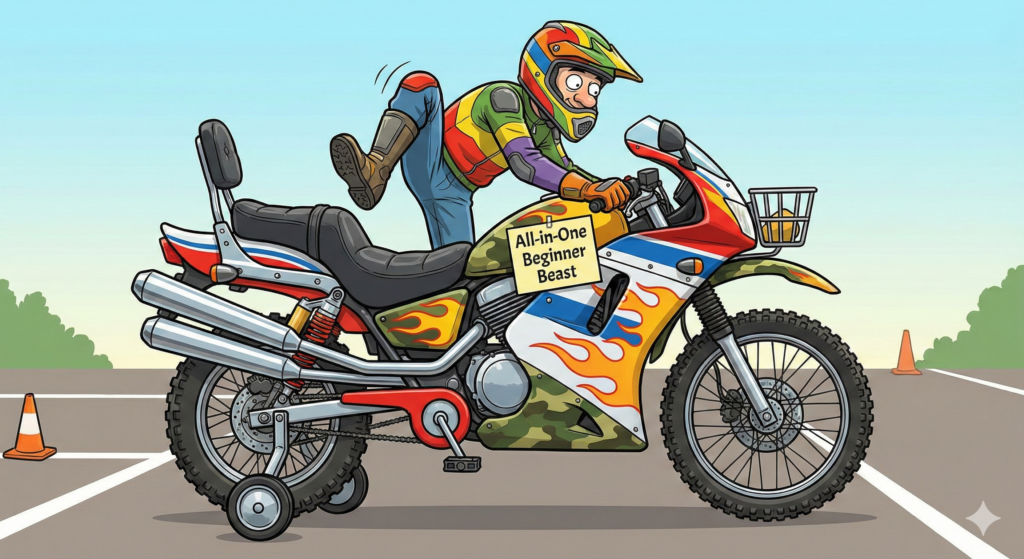
If you think buying your first motorcycle is a decision for life, you are wrong. One of my students spent last year on a city bike, worked out that it was not really his thing, and swapped it for an adventure bike before the summer was over. (Hello, Anton!)
A first bike is a piece of training equipment — do not treat it as the Holy Grail or as a life partner. Your first will not be your last.

When students ask me which motorcycle to buy first, I always answer: buy the one your heart is set on, the one you actually like. But! There is one “but”.

You see, for me a motorcycle means road dust, fifty shades of mosquito along Lake Peipus and thousands of kilometres a week. So an adventure bike suits me. I cannot recommend it to everyone, though. An adventure is superb, but if your feet do not reach the ground properly, there is a real risk of dropping it on its side at the traffic lights. I did exactly that early in my own riding career — I simply stopped badly at a junction (and yes, teaching people how to stop properly is now exactly what I do).

So do not be afraid to buy a bike that does not make you look like the toughest rider in town from day one. For me a motorcycle is not for Instagram pictures, it is for the soul. First we learn the basics at school, then you ride for a year or two, and only then do you trade up.

Do not be afraid to buy a bike for a single season, get to know yourself on it, and then pass the baton to the next beginner. That is not a marriage of convenience, it is an interesting introduction.

What I recommend when choosing your first bike

  • Stay close to the ground. You need to stand firmly with both feet down. Balancing on tiptoe in a Liivalaia traffic jam is a lottery.
  • Weight matters. A heavy cruiser is beautiful right up until you have to turn it around in a narrow car park. Start with something light and manoeuvrable. And if you do choose a cruiser, do not hesitate to come to the practice ground afterwards — we will work out together how to handle it safely and comfortably.
  • A litre is too much. Modern litre bikes are essentially sports equipment with lights bolted on. A beginner cannot enjoy riding them, because all the effort goes into not flying into the ditch after one accidental movement of the hand. Choose a mid-capacity bike for your first season. And if you still end up with something powerful, come to the practice ground and we will drill the skills you need on your own heavy machine.

My main advice: do not rush into buying a machine before you have started practical training at school. Only when you feel the clutch yourself, the weight of the bike and the way it responds to you on the practice ground will you understand what “character” you actually need. And then go for a test ride, because a motorcycle bought without trying it is foolish.

Remember, too, that buying a motorcycle with your last euro is the worst idea of your life.

Start with the gear

  1. Quality kit. A helmet that is comfortable, and protection you trust.
  2. Set money aside for servicing. There is nothing to add here. If you want to ride without brakes, it is better not to come to my school at all…

What next?

Choosing your first motorcycle is the beginning of a big adventure, and it is better to begin it in the right company. Once the plan is clear, have a look at how preparing for the category A riding test works.

At Motokool Kindel Lenks I do not sell pretty pictures. I teach the technique that keeps you in one piece. Tallinn has its own quirks: tram rails, sudden rain, milled-off asphalt and unpredictable drivers.

If you want to travel the road from a dream to riding with confidence, in a calm and professional atmosphere, let us start together.

Sign up and begin with the theory today, so you can enjoy the riding season in summer: category A training at Motokool Kindel Lenks.

A-kategooria sõidueksamiks valmistumine

Preparing for the category A riding test

Please note: motorcycle training is run by Motokool Kindel Lenks. Autokool Kindel Rool teaches category B.

On a motorcycle test it is not enough that the bike starts and the gears go in. Preparing for the category A riding test means being able to keep the machine under control both in a slow exercise on the practice ground and in city traffic, where decisions have to be made quickly but calmly. A good result comes from exercises repeated correctly, not from courage gathered the evening before. If you are still at the very beginning, it helps to see the whole picture first: here is how a motorcycle licence in Tallinn for a beginner works, step by step.
What is actually assessed on the category A riding test

The riding test checks, above all, whether you can handle a motorcycle in traffic independently and safely. The examiner is not looking for a perfect rider, but for someone whose actions are predictable, attentive and safe. A small inaccuracy does not have to end the test — a dangerous decision, insufficient observation or losing control of the bike can.

The test usually consists of exercises on the practice ground and riding in traffic. The exact set-up and requirements change over time, so it is worth checking them with your own instructor before the test — an instructor at Motokool Kindel Lenks knows what is being asked on the practice ground right now. More important than memorising the exercises is understanding why a particular technique is needed: your eyes steer the bike, the clutch and rear brake working together keep you balanced at low speed, and a correct riding position gives stability when braking.

In traffic the same logic is assessed, only more broadly. Do you notice the possible hazards at a junction? Do you choose your speed according to visibility and road conditions? Does your position in the lane give other road users a clear signal? A motorcyclist often has to anticipate other people’s mistakes as well. Knowing the traffic rules alone cannot replace that skill.

Preparing for the category A test starts on the practice ground

Practice-ground exercises feel the most stressful to many learners, because every uncertain movement is felt immediately. In reality the practice ground is the best place to learn the feel of the bike without the extra pressure of city traffic. Once slow riding, turns and braking are under control, more of your attention is free in traffic for observing and deciding.

In slow exercises the biggest mistake is pointing your eyes just in front of the front wheel. Look where you want to go — at the next gate, at the end of the turn, at the free space. The bike follows your eyes far more willingly than a beginner usually expects. Keep your upper body as relaxed as possible, because a stiff grip travels through the handlebars into the movement of the bike.

In faster manoeuvres, choosing the right speed, keeping your eyes up and using smooth control inputs become the decisive things. Accelerate and brake decisively, but not abruptly. A braking exercise does not only measure stopping distance: balance, keeping the bike straight and a controlled stop count just as much.

If an exercise does not work out, do not repeat it dozens of times in the same way. Stop, put the problem into words and change one thing at a time. Did your eyes drop too low? Did the clutch come out too fast? Did you start from the wrong speed? Constructive feedback turns a vague failure into a specific action for the next attempt.

Keep practising after it works

One successful attempt does not yet mean a reliable skill. On the test day nerves, colder asphalt, a different bike or simply more attention on you can all have an effect. A good sign is being able to do the exercise several times in a row and knowing yourself what you are doing at each stage.

At the same time, the goal is not to spend endless hours on the practice ground. Once the basic technique is there, it needs to be kept fresh while the focus moves to traffic. An instructor helps you find that balance: one learner needs more work on slow manoeuvring, another on observation or cornering.

In traffic, riding ahead of the situation is what counts

On a motorcycle, visibility and space are your safety buffer. Keep enough following distance, stay out of blind spots and choose a position in the lane that helps you both see and be seen. This does not mean mechanically following one fixed line. The right position depends on the bend, the road surface, oncoming traffic, parked cars and the weather.

At junctions it pays to think two steps ahead. Before you start a turn or pull out onto a main road, judge not only whether the road is clear right now, but also what other road users intend to do. An indicator is not yet a guarantee that a car will really turn. An oncoming driver may also misjudge a motorcycle’s distance or speed.

On the test, necessary observation is often skipped not out of ignorance but out of haste. Give yourself a clear order of actions: check the mirrors, check the blind spot, signal in good time, choose a suitable speed — and only then change direction. Once that order becomes a habit, you do not have to recall it under pressure on the test.

In Tallinn traffic it is worth practising a range of situations: busier junctions, multi-lane roads, areas around tram tracks, pedestrian crossings and quieter side streets. The aim is not to learn one test route by heart. The aim is to be able to read traffic even when the situation is new.

Gear and knowing your bike add calm

On the day of the test no detail of your gear should come as a surprise. The helmet has to sit firmly, the gloves have to let you feel the levers, and the boots have to give safe footing. New gear that has not been broken in can take your attention even when it is of good quality.

Get to know the bike you are taking to the test as well. Practise its clutch bite point, the sensitivity of the brakes, the turning radius and the riding position. If the training bike differs from what you have ridden before, give yourself time to adapt. Motorcycles within the same category can behave quite differently.

Before you set off, do a calm check: is the gear fastened properly, are the mirrors set and are the controls familiar? This is not a ritual for the examiner — it is a way of taking control before you start moving.

How to make test nerves work for you

Nerves do not mean you are not ready. More often they mean the outcome matters to you. The problem starts when you try to force the nerves down and end up changing your usual rhythm because of it.

On the test day, do not try to ride faster, bolder or more precisely than you did in your lessons. Ride by the same principles you have used again and again: look far ahead, leave yourself space, make decisions early and do not rush. When you are given a riding instruction, listen to it to the end. If it stays unclear, ask again — guessing is a worse choice than a calm clarification.

One small mistake is no reason to panic. If a gear does not go in on the first try, or a stop is not quite as smooth as you wanted, focus on the next action. The examiner assesses the whole ride. Rushing after a slip usually causes more problems than the original mistake.

The last week before the test

In the final week, do not try to fix everything at once. Concentrate on the two or three things you have agreed with your instructor that have the biggest effect on your riding. They might be slow manoeuvring, braking, observation at junctions or smooth lane changes.

Plan your lesson so that there is not too long a gap between the last practice and the test. At the same time, avoid overloading yourself. A tired learner starts making mistakes they would not make when rested. Sleep enough, eat something light before the test and arrive with time to spare.

Good preparation is no promise that everything will go perfectly in every situation. What it does give you is the confidence that you can react calmly when something unexpected happens. Ride smart, ride with control — that is the best attitude both on the test day and on your first ride out alone.

Mootorratta juhiluba Tallinnas algajale sõitjale

A motorcycle licence in Tallinn for a beginner rider

Please note: motorcycle training is run by Motokool Kindel Lenks. Autokool Kindel Rool teaches category B.

Your first time in the saddle does not have to start with fear or confusion. A motorcycle licence for a beginner in Tallinn means, above all, learning to ride step by step: first you understand how the bike responds, then you practise in a controlled environment, and only then do you bring those skills into real city traffic. The goal is not simply to complete the exercises on exam day, but to feel genuinely secure in traffic once you hold your licence.

Choose the category that suits your age and your bike

A motorcycle licence is not a single category. The right choice depends on your age, your previous riding experience, and the power and engine size of the bike you want to ride later.

Category A1 is intended for lighter motorcycles and can be applied for from the age of 16. Category A2 suits motorcycles up to 35 kW and is generally available from the age of 18. Full category A entitles you to ride motorcycles without restriction. The usual age limit for it is 24, but with category A2 experience you can reach category A earlier.

If you are a complete beginner, do not choose a category purely on the basis of which bike looks most exciting. It makes more sense to think about where and how you will actually ride. In the city and on shorter everyday journeys, a lighter and more manageable bike will give you more confidence than an over-powered machine. If your goal is a larger motorcycle or longer trips on the open road, look at the requirements for category A and at what your age allows.

Always check the current conditions for the categories and the health requirements before registering for a course. That way you start in the right order and do not discover later that the training you chose does not match your plan.

A beginner’s motorcycle licence starts with the theory

Theory is not merely memorising road signs. A motorcyclist has to read traffic with particular care, because they are smaller and less noticeable to everyone else. Many dangerous situations arise at junctions, during lane changes or on left turns – precisely when a car driver fails to notice an approaching motorcycle in time.

So in the theory you learn to judge distances, speeds and visibility. You also come to understand why a wet road surface, tram rails, road markings, gravel or autumn leaves can change a motorcycle’s grip so quickly. In a car a small irregularity may go almost unnoticed; on two wheels it directly affects your balance and your braking distance.

E-learning suits someone whose working or school days are full. You can study at your own pace, but the theory is most useful when you tie it straight to practical riding. If you have just studied braking distance or blind spots, ask your instructor in the next lesson what that looks like in real traffic. The knowledge sticks far better that way.

The first lessons: control before speed

A beginner’s biggest worry is usually balance. In fact nobody expects you to arrive at your first lesson as a finished rider. Teaching normally starts very calmly: getting to know the motorcycle, the correct riding position, coordinating the clutch and the throttle, and moving at low speed.

The exercises on the training area may seem simple at first, but they are the foundation of everything that follows. Riding slowly teaches you to look where you want to go, rather than at the obstacle in front of you. Braking exercises help you feel the role of the front and rear brakes. Turns, slalom and avoidance manoeuvres develop your balance and the coordination of hand, eye and body.

Do not compare yourself with a fellow learner who has ridden a scooter before or has more traffic experience. Some pick up the feel of the clutch quickly; others need more repetitions. What matters is not the number of lessons, but whether you can perform the exercise calmly, deliberately and ever more smoothly.

Riding in Tallinn teaches you to anticipate

On the training area you learn to control the bike; in the city you learn to anticipate risk. In Tallinn that means paying close attention to tram tracks, bus lanes, dense traffic, multi-lane junctions and frequently changing road conditions. For a motorcyclist, good reactions alone are not enough. Far more valuable is the ability to see a dangerous situation a couple of seconds earlier.

In practical training you work on choosing your position in the lane, keeping a sufficient gap and staying visible. You also learn when not to rely on how you expect others to behave. A car may signal a lane change far too late, or not at all. A safe rider leaves themselves room, watches the wheels and the driver’s movements, and prepares to brake before the situation turns sharp.

Evening and weekend lessons in Tallinn are practical not only for fitting around your schedule. They let you experience different traffic densities. At quieter times you can practise harder manoeuvres calmly; in heavier traffic you learn to keep up with the pace. Both skills are needed in real life.

Gear is not a side issue

Your riding gear has a direct effect on your safety and your concentration. A helmet has to sit securely without pressing. Gloves help you hold the bars steadily and protect your hands in a fall. A jacket, trousers, boots and armour reduce the risk of injury, but they also give you a better sense of your body and shelter from wind and rain.

A beginner does not have to buy the most expensive gear straight away. But do not choose on looks or a discount alone. Always try a helmet on, check the fastening, and move around in the gear. If a boot is too stiff or a glove restricts your fingers, using the clutch and the brake becomes awkward. Comfort supports your attention, especially during a longer lesson.

How to prepare sensibly for the state exam

Preparing should not mean panic in the final days. The best result comes from practising consistently and understanding why a particular mistake happens. If you brake too abruptly, look too close in a turn, or lose your balance at low speed, that is not a character flaw. It is a specific skill that the right repetitions will fix.

Before the exam it is worth doing at least one ride in as close to exam conditions as possible. It helps you notice whether nerves scatter your attention, whether you tend to rush, or whether you hesitate too long before deciding. Your instructor’s feedback is especially valuable at that point if it is specific: what to do differently, when to do it, and how to check the result in the next exercise.

In the theory exam, read the questions all the way through. In the riding exam, do not try to guess what the examiner is thinking. Concentrate on the rules, your observation, smooth control and a safe decision. Sometimes the most mature decision is to wait a second longer, because visibility is not good enough.

If you feel fear or uncertainty at the start

Riding a motorcycle feels far more immediate to many people than driving a car. It is more immediate: balance, weather, road surface and speed are all felt through the body. Anxiety does not mean motorcycling is not for you. Usually it just means you need a clearer structure and calm practice.

Good training does not push a learner into a difficult situation before the basics are in place. If an exercise does not work, it is broken into smaller parts. A problem with a slow turn, for instance, may not lie in the turn itself but in where you are looking, in tense arms, or in uneven clutch control. Once the cause is known, the solution becomes reachable.

In Tallinn, category A training is run by Motokool Kindel Lenks, with an individual approach to every learner. Your first lesson does not have to prove that you are already a bold rider. It has to give you a clear next step.

Ask the right questions before starting a course

When choosing a course, look beyond the price. Ask when the lessons take place, what bikes you will learn on, how the theory is organised, and whether extra lessons are available if you need them. For a beginner it also matters whether the instructor explains mistakes clearly and leaves enough time to correct them.

The fastest route to a licence is not always the shortest one in the calendar. If your work schedule is tight, a flexible evening or weekend lesson may be worth more than a cheaper course at times that do not suit you. If you have ridden before, progress may come faster. If you are starting from zero, give yourself permission to learn at your own pace.

Becoming a motorcyclist starts with your first calm pull-away, not your first fast ride. Once you learn to look far ahead, brake deliberately and leave yourself room in traffic, the licence is simply one natural step on the way to becoming a skilled and confident rider.

Seven simple steps to your driving licence

Seven steps to a driving licence

How does training work at Autokool Kindel Rool in Tallinn?

1. First step – signing up
Get in touch with Autokool Kindel Rool. Call 55 44 007, write to us on Messenger, or fill in the form on our website. Based in Tallinn, Autokool Kindel Rool exists to help you obtain your category B licence quickly and effectively.

2. Trial lesson – free and with no commitment
The trial lesson lets you get to know our school and our training cars and try driving with no obligation. In the trial lesson we:

  • introduce you to how the driving training works,
  • go through the basics of how the car is built,
  • practise setting up the driving position and pulling away.

📍 Lessons take place in the evenings and at weekends at the Kadaka Selver training ground.
📊 According to research, 47.1% of learners change driving instructor during their training (J. Koor, 2024). Our aim is to give you a quality training process from beginning to end.

3. Signing the training contract
If you are happy, we sign a training contract setting out the price and the payment terms. Payment in instalments is possible.

4. Theory through e-learning on Liikluslab.ee
In the modern Liikluslab.ee e-learning environment you can study the basics of traffic at your own pace. Three key topics are covered over Zoom. The course ends with the driving school’s theory exam and the Transport Administration theory exam. First aid training is included in the theory course.

5. Driving lessons in Tallinn
Practical lessons start once 75% of the theory is complete. There are 30 driving lessons in total, including night driving and the slippery-road session. Lessons start from the Kadaka Selver car park.

6. Practical exam at the driving school
The practical exam lasts 60 minutes and is conducted in the same way as the Transport Administration exam.

7. The Transport Administration exam and your licence
Once you pass, you hold category B driving entitlement.

Kindel Rool – drive smart, drive with confidence!
A Tallinn driving school that helps you make your licence a reality.

Mandatory direction or one-way street?

In lessons I often see learners mix up “One-way street” (a rectangle) and “Mandatory direction of travel” (a circle). That is completely normal while you are learning – nobody learns without getting it wrong first. Below is a simple rule that makes the difference clear fast.

A round blue sign and a rectangular blue sign with arrows, side by side
Two similar arrows, but different meanings: a circle (an order) versus a rectangle (information about the street).
Mandatory direction sign: a blue circle with a white arrow pointing left
A circle is an order, one single option. From here you MUST go in the direction of the arrow.
One-way street sign: a blue rectangle with a white arrow pointing left
A rectangle is shaped like a road – long and straight. The whole street runs in one direction.

The rule: shape → meaning

CIRCLE = direction, an order
At the junction you MUST travel in the direction of the arrow.

  • Arrow to the right → right turn only
  • Arrow to the left → left turn only
  • Arrow straight ahead → do not turn, drive straight on

RECTANGLE = information about the street
It describes the street – traffic is permitted only in the direction of the arrow (a one-way street). Nobody drives the other way along it.

How to tell them apart in a second

  • Look at the shape first – a circle (an order) or a rectangle (information).

Three common mistakes and what to do about them

  • “A circle always means a turn.” Not necessarily. If the arrow points straight ahead, the order is not to turn but to carry straight on.
  • “A rectangle obliges you to turn.” No. It tells you that this street runs in one direction.
  • “I did not notice the sign at the start of the street or at the junction.” Look at the signs on the side street – if you see a rectangular plate, it is probably a one-way street.

Quick answers

Does a circle with a straight-ahead arrow mean I have to speed up?

No. It means the permitted direction is straight ahead only. Turning off is not allowed.

Where should I position the car on a one-way street when turning left?

At the left-hand edge.

Practise these signs in real situations

We make the signs make sense, rather than something to memorise. Category B courses in Tallinn – the trial lesson is free.

Book a trial lesson Ask on Messenger

Pass the Transport Administration driving test first time? Kindel Rool prepares you properly

The final polish

Did you know that, according to the statistics, more than half of the learners at Tallinn driving schools fail the state driving test on their first attempt? Many schools send their learners to the test hoping for the best. That is not how we work.

At Autokool Kindel Rool the rule is simple: if you have completed our training and been given the green light, then you CAN drive. We do not send anyone to the Transport Administration half-prepared. That is exactly why we are confident enough in our learners to launch a programme unique in Tallinn: pre-exam driving lessons.

Why do we give you 2 FREE lessons right before the test?

This is not remedial training for people who cannot drive. Quite the opposite — it is top-tier preparation for those we have already polished to near-professional level.

  1. We trust our own quality. Our school’s pass rate (as of 01.08.2026) is 61.9%. That is 1.43 times higher than the Tallinn average. We know you are ready, and these two lessons are simply the final chord before your win.

  2. No cold start. Even the best of us need a warm-up. These two lessons immediately before the state exam are there so that you sit down beside the examiner already warmed up, having just driven through Tallinn’s busiest junctions.

  3. Professional fine-tuning. Our teachers are not merely instructors but mentors. In these final lessons we consolidate your skills so that the state exam feels like nothing more than another pleasant drive.

We teach well because tomorrow we share the same road with you. We are not selling you a licence — we are giving you skills and confidence that last a lifetime.

Frequently asked questions — your route to success

? What is the best way to get to know a driving school in Tallinn?

The best way is to come to our free category B trial lesson. Unlike an ordinary drive through the city, it takes place on the Kadaka training ground in Tallinn. It is a closed, safe area where you can try the car without the stress of traffic, get a feel for the pedals and the wheel, and see how we teach. There is no obligation at all. Read more and book here.

? What exactly happens in the trial lesson?

In the trial lesson we introduce you to how the training works and to the basics of how the car is built. Even if you have never sat behind the wheel, we make your first experience a safe one. Our aim is to make contact and to find out whether the school and our way of teaching suit you.

? Why is Kindel Rool’s pass rate so high?

Because we do not compromise on the quality of the training. Our team includes experienced specialists, among them a former examiner from the Transport Administration, who know exactly what is expected in the exam. We prepare you for real life, not only for the test.

? How do the free pre-exam lessons work?

These two lessons are part of our new category B package. They are scheduled immediately before your state driving test in Tallinn, so that your confidence and your technique are at their peak exactly when it matters most.

? Can I learn on both a manual and an automatic?

Yes, in Tallinn we offer training on both manual and automatic cars. Read more about learning on an automatic.

Driving school curricula

Here you can download the category B, A, A1 and A2 curricula in PDF format. The documents are issued in Estonian, as required for official curricula. For details about the courses themselves, see:

Category B curriculum

Category B curriculum (PDF)

A description of the driving and theory volumes, the aims and the learning outcomes.

Category A curriculum

Category A curriculum (PDF)

Manoeuvring area and road training topics, safety skills, and the requirements for completing the course.

Category A2 curricula

A2 initial training curriculum (PDF)

Initial training for category A2: topics, volumes and aims.

A2 further training curriculum (PDF)

Further training for category A2: requirements and learning outcomes.

Category A1 curricula

A1 initial training curriculum (PDF)

Initial training for category A1: topics and learning outcomes.

A1 further training curriculum (PDF)

Further training for category A1.

Why I started my own driving school

Hello, friends!

Alexey, founder of Autokool Kindel RoolI am Alexey, the founder of Autokool Kindel Rool. Today I want to share the story that led me to start my own driving school – and to decide what kind of school it had to be.

A little over a year ago I was training for category CE. A truck and a trailer – quite a challenge, isn’t it? But what really shocked me was the way I was taught. In the first lesson the instructor walked alongside my truck and shouted through the window about how I should be turning the wheel. It felt more like training animals than teaching people.

And then came the part that still makes me shake my head: in the lessons that followed, the instructor simply slept in his car while I tried to work out from my own mistakes how to handle that “damned” trailer.

A bad instructor asleep in the car

Naturally I had to take extra lessons, because the results of that kind of “teaching” fell far short of what I wanted. At one point I even thought about changing schools, but in the end I passed the exam – on the second attempt.

After that experience I asked myself: why do so many driving instructors forget that teaching should be a supportive and respectful process, not a school of stress and fear? Is it not our job to help learners grow into skilled and confident drivers?

That is where the idea came from – to do things differently. At Autokool Kindel Rool our aim is to create a friendly and supportive learning environment where teaching happens through cooperation. Our instructors are specialists in their field, and they:

  • help you at every step,
  • never shout and never belittle you,
  • focus on making sure you feel confident behind the wheel and can cope safely in traffic.

And above all – we do everything we can to help you pass the exam on your first attempt.

If you are looking for a driving school right now, get in touch. Not looking yet, but planning to? Follow our page. Do you love cars and motorcycles? Join our community.

Share your own experiences in the comments below, and together we can help build a better road culture.

Autokool Kindel Rool – drive smart, drive with confidence!

Before the category B driving test: what to remember

The category B driving test is an important step towards your licence. Many mistakes happen right at the start of the test, in the checks you make before pulling away. The checklist below will help you prepare better and act calmly and confidently on the day.

1. Starting the engine and checking it

  • Get into the car and start the engine with the key, not a button.
  • Make sure the engine is running — the revs must be above zero.
  • In an automatic, the engine will not start if a gear (D or R) is selected. Move the selector to P and try again.
  • Check that no red warning lights are showing on the dashboard before you set off.
KIA key
The KIA key
KIA rev counter (RPM)
The revs must be above zero
Automatic gear selector diagram
Selector in P before starting
Dashboard warning lights
No fault lights should stay lit on the dashboard

2. Setting up the driving position

Adjust the seat, the backrest, the head restraint and all the mirrors. If you notice while driving that a mirror is not set correctly, stop where it is permitted and adjust it — adjusting while moving is not allowed.

Mirror adjustment controls
Adjusting the door mirrors

3. Before pulling away

  • Leave the lights on AUTO only when there is no rain, snow, fog or dusk – the car often fails to detect poor visibility and the rear position lights stay off. In those conditions switch on the dipped beam yourself.
  • In rain or fog, switch on the A/C to stop the windows misting up and distracting you.
  • The handbrake is mechanical — practise in a car with the same arrangement.
  • Check once more that no red warning lights are showing before you set off.
Light switch
1 — off, 2 — AUTO, 3 — position lights, 4 — dipped beam

A typical mistake — leaving the handbrake on.

Handbrake warning light
The handbrake warning light

4. Pulling out of a parking space

  • Always look right and left — this is one of the most common test mistakes.
  • Do not turn the wheel fully straight away. Pull out halfway, then start turning while watching the cars parked beside you.
  • When reversing, give way to everyone. If someone is approaching, go back into the space and do not obstruct traffic.
  • Always use the indicator: when stopping, when pulling away and for every manoeuvre.

5. What to know about the test area

  • A 10 km/h speed limit applies on the Transport Administration test area on Heli street.

6. Get to know the test car

The Transport Administration uses Kia Ceed vehicles. Read through the exam description and the possible questions on the Transport Administration website in advance, and have a look at the Kia owner's manual.

Book a FREE trial lesson

Questions? Write to us on Messenger or call +372 55 44 007

Tallinn driving schools pass rate, category B, last 60 months, data as of 01.08.2026

Tallinn Driving Schools Pass Rate (Last 5 Years)

Source: Transpordiamet • Data as of: 01.08.2026
TOP
Autokool Kindel Rool
TALLINN
1st Try
Retry
ESTONIA (TOTAL)
Selected school
TALLINN
1st Try
Retry
ESTONIA (TOTAL)

All our instructors have completed the professional courses at Tallinn University Haapsalu College.

Driving test pass rates at Tallinn driving schools: how to choose the best one?

We compare driving schools in Tallinn by their category B driving test pass rates over the last 5 years. We look separately at how learners do on the first attempt and at retests. Data source: the Transport Administration public statistics.

When you choose a driving school in Tallinn, the fairest measure for comparing them is their driving test pass rate. Statistics do not lie – over a long period they show how well a school actually prepares its learners.

Data source: public statistics from the Transport Administration (category B driving tests at the Tallinn offices – Heli, Teelise, Valge). Download the data.

How are the results calculated?

  • Period: We use official statistics for the last 5 years (60 months). That gives a statistically reliable and stable picture.
  • Location: The main focus is on tests in Tallinn (Heli, Teelise, Valge). As additional information we also show each school results across Estonia as a whole.
  • Attempt analysis: We show the statistics separately:
    • First attempt: what share of learners pass the test straight away.
    • Retests: the pass rate on the second and subsequent attempts.
  • Comparison: The system calculates how many times more often learners at the selected school pass the test compared with a competitor or with the Tallinn average.

This thorough approach (a long period plus separating the attempts) rules out random fluctuations and shows the real standard of each school.

Why does the first-attempt pass rate matter?

A high pass rate on the first attempt shows that the driving school does not send a learner to the test to have a go, but when they are genuinely ready. That saves the learner time, money (state fees, extra driving lessons) and nerves. The retest statistics, in turn, show how well a school can analyse mistakes and help a learner to learn from them.

Autokool Kindel Rool – consistent quality

Autokool Kindel Rool stands out because we have our own instructors and our own vehicles – we do not subcontract the service. We take responsibility for every learner result ourselves.

Our team also includes Igor Karogezjan, a former examiner at the Transport Administration. His experience helps us refine the curriculum so that learners are ready to drive safely and confidently in any situation – and the statistics confirm it with consistently strong results.

Pass rates at Tallinn driving schools (5-year average)

The comparison above shows the category B driving test statistics. Choose a school from the dropdown to compare it with Autokool Kindel Rool.

Frequently asked questions

Where does the data come from and what period does it cover?

We use the Transport Administration official statistics. This comparison is based on data from the last 5 years (60 months), which gives the most objective long-term view.

What is the first-attempt pass rate?

It shows the percentage of a given school learners who pass the driving test successfully on their first attempt. This is the key quality indicator, and it points to good preparation.

Why are Kindel Rool results consistently good?

The reasons are systematic training, our own salaried instructors (not subcontractors), and involving a former examiner in the training process, which helps avoid the typical mistakes made in tests.

Choose a driving school in Tallinn that prepares you for real life

If you want your category B training to run steadily and with a clear purpose, come to Kindel Rool. Our goal is not only the exam, but safe and thoughtful driving after you have your licence.

How long does the driving test take?

The length of a test also says something about how far a candidate gets. According to 2025 data, a driving test in Tallinn lasts 34.5 minutes on average, and 40.5 minutes for Kindel Rool students. A passed test takes exactly the same time in both cases — 46.8 minutes. The difference comes from failed attempts: in Tallinn the drive ends after 25.3 minutes on average, for our students after 29.1. A short test usually means the drive was stopped early.

TestTallinn averageKindel Rool
All tests34.5 min40.5 min
Passed46.8 min46.8 min
Failed25.3 min29.1 min

Duration figures are for 2025. The pass-rate comparison above updates continuously.

Last updated: . Source: Transport Administration.

Autojuht rooli taga, mõttemull peas – tähelepanu ja otsused, mitte ainult tehnika

Why Driving Is 80% Psychology and Only 20% Technique

Many people think driving is just a simple sequence of actions: turn the key, select a gear, turn the wheel. Perhaps also memorising what the road signs mean. But in a world of constant change — in Tallinn, restrictions are introduced and lifted, whole streets are rebuilt, tram lines are laid — technical literacy and memorised signs are no longer enough. Today’s traffic is a demanding intellectual environment, where every decision has to rest on your thinking as well as your reflexes.

Responsibility and investment

Anyone starting at a driving school has to recognise what they are taking on: responsibility for their own life, for the lives of the people close to them, and for strangers. I should not be afraid to share the road with that driver afterwards.

Getting a licence must not be treated as a formality: clocking up the compulsory hours and turning up to the exam hoping for the best. It is an investment in your future. The traditional model at many Tallinn driving schools amounts to drilling learners on the exam routes en masse. But that model ignores the most important competence of all — one that is assessed in the exam too: driving independently. Often a learner passes the exam and only then starts “learning” to drive in real life. That approach is dangerous, because it leaves one question unanswered: how does a person behave on the road alone, with no instructor beside them as a safety net?

From instructor to mentor

The goal of genuinely good training is to build habits that let a driver feel confident in any unpredictable situation. This is exactly where the line runs between an ordinary driving instructor and a mentor.

At Autokool Kindel Rool we have introduced a mentoring system for those who value a deliberate approach. Drawing on knowledge gained at Tallinn University’s Haapsalu College, we help learners develop “traffic intelligence” — the ability to notice, analyse and anticipate how events will unfold. We teach people to understand how their emotional state directly affects safety.

The GDE matrix: where safety actually lives

Why do even experienced drivers end up in crashes that could have been avoided? The answer comes from the European training standard — the GDE framework (Goals for Driver Education). This matrix presents driving as a four-storey pyramid:

  • Level I: Vehicle handling. The basics: pedals, gears, manoeuvring.

  • Level II: Driving in traffic situations. Interacting with other road users, following the rules and adapting to the traffic.

Most schools focus on these two levels alone. The craft of the Kindel Rool mentors begins on the “upper floors”, where we teach you to take charge of a situation before it becomes dangerous:

  • Level III: The goals and context of the drive. Why are you behind the wheel? Are you in a hurry? Irritated? Carrying children? This level teaches you to plan a particular journey and assess its risks.

  • Level IV: Personal goals and life skills. The deeper layer of values and self-control. How you handle impulsiveness in life is directly reflected in the gap you keep to the car ahead in heavy traffic.

How we turn theory into a skill that is yours

To make the training a real investment, we use specific methods:

  1. Deliberate planning. Every lesson starts by consolidating what came before. It is a complete process with a clear plan, not aimless circling around the Transport Administration.

  2. Commentary driving. We ask learners to say their intentions and the risks they notice out loud. This helps the mentor understand the logic behind your decisions and shape the right thinking pattern.

  3. The Clean Language technique. We do not issue blunt commands — we ask. Instead of “Brake!” you will hear: “What can you see ahead, and what would be the best action right now?” We activate your brain rather than merely drilling reflexes. The most reliable experience is the one born in your own mind.

  4. Debrief and reflection. Every lesson ends with self-analysis. Road-safety research points consistently in the same direction: training that focuses on vehicle handling alone does not reduce later crash risk – what does is training that builds hazard perception and an honest sense of your own limits.

The trap of imagined mastery

Almost every second driver considers themselves “better than average”. In psychology this is known as a self-enhancement bias. Beginners overestimate their abilities, while experienced drivers underestimate external risks. Without objective feedback, the brain reads the absence of crashes as proof of skill — when often it is simply luck.

Training with us helps to recalibrate your perception. A good driver is not the one who recovers brilliantly from a skid, but the one with the sense not to end up in one.

Driving as a life skill

The road is the most honest test of maturity there is. It reveals your real habits and your level of emotional intelligence. Someone who keeps a clear head in heavy traffic will handle a crisis more effectively in any other area of life.

By choosing mentoring over being drilled for the exam, you learn to take charge not only of the car, but of yourself.

Start your deliberate journey

The best way to understand the difference is to try it for yourself. We invite you to a free trial lesson at Autokool Kindel Rool.

In the lesson you can:

  • Meet our mentors.

  • See the GDE method in practice.

  • Ask any questions you have about the training.

That first meeting will show you what we mean: training with us is not merely a route to a licence, but a route to a calm and safe future.

Book your trial lesson today and feel what a steady wheel in your hands really means.

Sõiduhirmu ületamine autokoolis rahulikult

Overcoming a Fear of Driving at Driving School

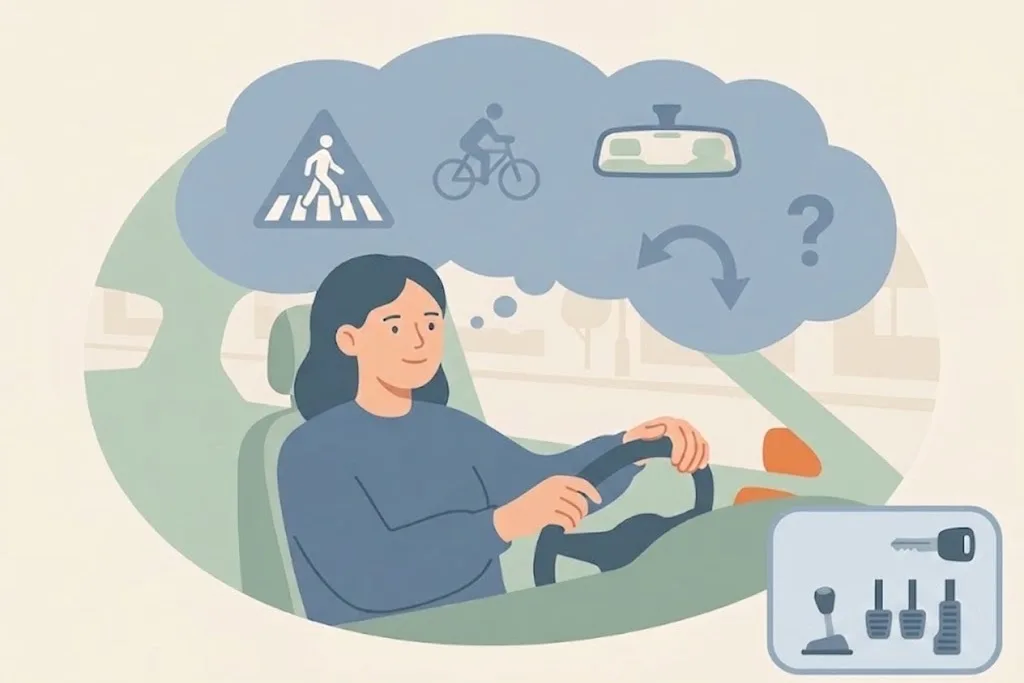
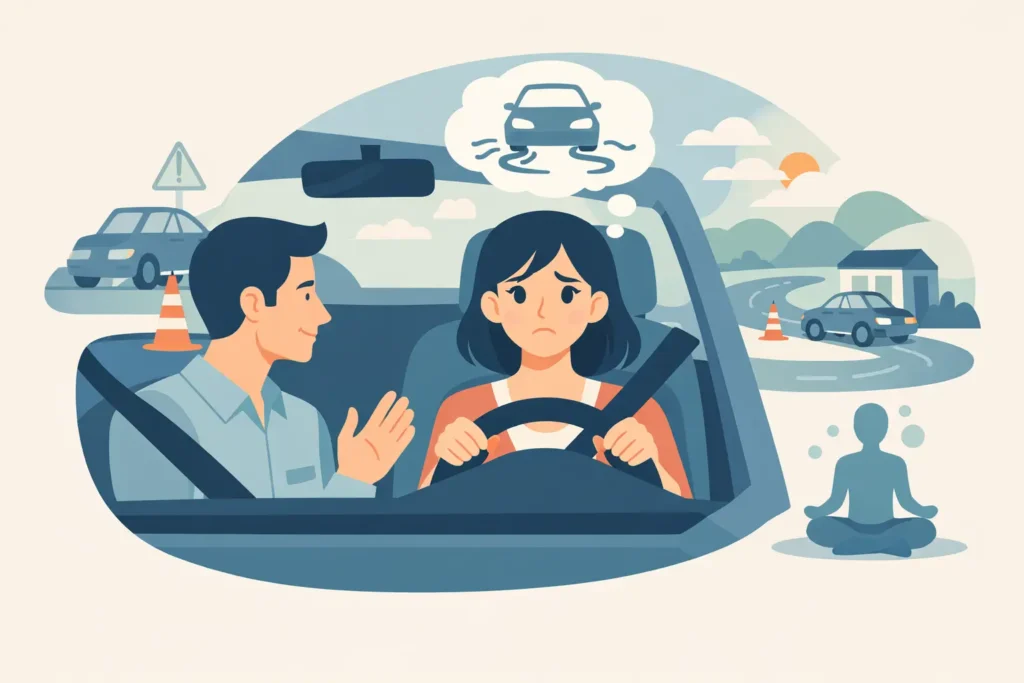
Your first time in dense Tallinn traffic can feel like too much at once: mirrors, gears, pedestrians, traffic lights, a bus moving in the next lane, and an instructor calmly saying that you turn right at the next junction. Overcoming a fear of driving at driving school does not mean the discomfort has to disappear in the very first lesson. It means learning to act alongside the fear, so that every drive adds control rather than tension.

A fear of driving does not show that you could not become a good driver. Often it shows the opposite: that you take the responsibility seriously. With the right guidance, enough practice and a clear plan, that initial anxiety turns into the ability to read traffic, make decisions and drive independently.

Why does a fear of driving arise?

Driving requires several new actions at once in the beginning. In a manual you have to feel the clutch and choose a gear; in an automatic you can focus on the traffic sooner. In both cases you have to learn to look well ahead, keep your distance, judge the intentions of other road users and make decisions under time pressure.

Fear is often amplified by the wish to do everything flawlessly. The learner is afraid the car will stall at a junction, that they will miss a sign, or get in the way of drivers behind. In reality, a lesson is exactly the place to experience those situations safely. The instructor’s job is not to wait for a perfect performance, but to help you understand what happened, why it happened, and what to do differently next time.

For some people the anxiety has a specific cause: an unpleasant lesson in the past, a failed exam, witnessing a crash, or a long break after getting a licence. In that case “don’t be afraid” is not enough. What is needed is a calm pace and exercises that restore trust in your own decisions.

Overcoming the fear starts with a suitable pace

Not everyone starts from the same level. One learner has already driven on the open road with a parent; another sits behind the wheel for the first time. Training therefore has to move from simpler to harder, not the other way round. The first lessons can focus on the feel of the car, smooth braking, turning and calm driving on quieter streets.

Once the basics become familiar, junctions, roundabouts, parking, denser city traffic and higher speeds are added. This gradual build-up matters, because confidence does not come from simply covering more kilometres. It comes from the experience of coping with an increasingly demanding situation.

Pace does not mean dragging things out indefinitely, though. Too long a gap between lessons can increase anxiety, because each time you have to start again as if from scratch. A regular rhythm suits many people — one or two lessons a week. Evening and weekend slots help keep that rhythm alongside work or studies.

Tell your instructor what actually troubles you

At the start of a lesson it is worth saying directly if you are afraid of, say, left turns, lane changes, parking or joining a main road. That is not weakness and not an excuse. The more precisely your instructor knows where the tension sits, the more purposefully the lesson can be built.

Good feedback is specific. Instead of only hearing “be more attentive”, a learner should understand where to direct their gaze, when to reduce speed, and which sign or situation the decision follows from. For a lane change, a clear order of actions helps: check the mirrors, signal, check the blind spot, choose the right moment and move across calmly. When the action is broken into small steps, the brain does not have to solve everything at once.

Constructive guidance does not mean mistakes go uncorrected. On the contrary, they should be discussed immediately and clearly. But a mistake should not turn into a label along the lines of “you can’t do this”. It is one situation, one cause, and the next chance to practise the same technique better.

Practise the situation that frightens you, deliberately

Avoidance brings relief for a moment but keeps the fear alive. If roundabouts create tension, you do not have to take the most complex one at rush hour on your first attempt. You can start at a quieter time and with a simpler layout. Once the principle is clear, you can move step by step to more demanding situations.

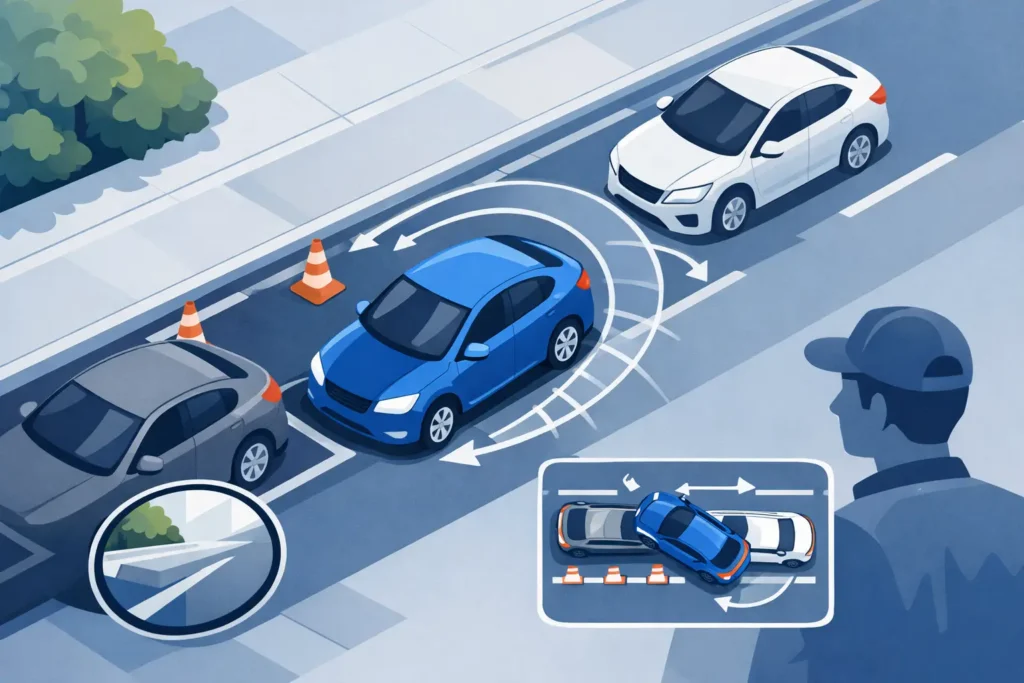
The same goes for parking. A fear of parking does not disappear from doing the exercise once before the exam. Repetition teaches you to notice the car’s position, use the mirrors and correct calmly. In real traffic the aim is not to park in a single movement. The aim is to complete the manoeuvre safely, stop if needed, reassess and adjust.

If the fear is tied to the exam, it is worth practising exam-style drives as well. That means more independent decisions, different types of road, and situations where the instructor does not prompt every step. It becomes clearer which skills are already solid and which still need repeating. The exam does not have to be a leap into the unknown — it is a chance to show what you have consistently practised.

Simple ways to help yourself when anxiety rises

While driving, there is no need to fight the anxiety or pretend it is not there. Notice it and bring your attention back to the task. Before setting off, adjust the seat, mirrors and steering wheel so that your body is comfortable. A drive started in a rush raises the tension before the first junction.

If you feel your thoughts sliding into panic, use a short internal plan: I look ahead, I check my speed, I keep my distance. That directs your attention to what you can do right now, rather than to what might go wrong.

It also helps to note down, after a lesson, one thing that went well and one situation you want to practise next time. Under fear, the brain tends to remember only the mistakes. Noticing concrete successes gives a truer picture of your progress.

Manual or automatic: choose what suits your learning

The choice of gearbox can noticeably affect your confidence. A manual gives you more technical skill and a category B licence that lets you drive both manual and automatic cars. It does, however, demand more attention at the start for the clutch, the gear changes and a smooth pull-away.

An automatic reduces the technical load, and many anxious learners can turn to reading traffic sooner. That choice comes with a restriction on the licence to automatic vehicles. The right choice is not decided by other people’s opinions, but by your real needs, your future car and the goal of your training.

When a past experience has knocked your confidence

A failed driving test does not prove you are unsuited to driving. The result can be affected by nerves, the unfamiliar exam setting, one difficult junction, or a skill that was not yet automatic enough. It is important to avoid two extremes: going straight back to the exam without analysing the cause, but equally not waiting a long time out of fear.

Further training makes sense when you need specific support before a new exam, or want to cope more confidently in traffic on your own after getting your licence. Sometimes a few targeted lessons are enough; other times a person needs more time. It depends on whether the issue is a single manoeuvre, applying the rules, or broader anxiety.

Autokool Kindel Rool’s category B training is built on exactly this principle: teaching has to develop real traffic skill, not only a feel for the exam route. Calm, individual guidance and regular practice let a learner move from a weakness to the next strength.

In your next lesson you do not have to prove that you are fearless. It is enough to be ready to make one more considered decision than last time. That is how confidence behind the wheel grows — the kind that stays with you long after you have your licence.

Kas automaadiga saab manuaali juhtida ohutult?

Can You Drive a Manual With an Automatic Licence?

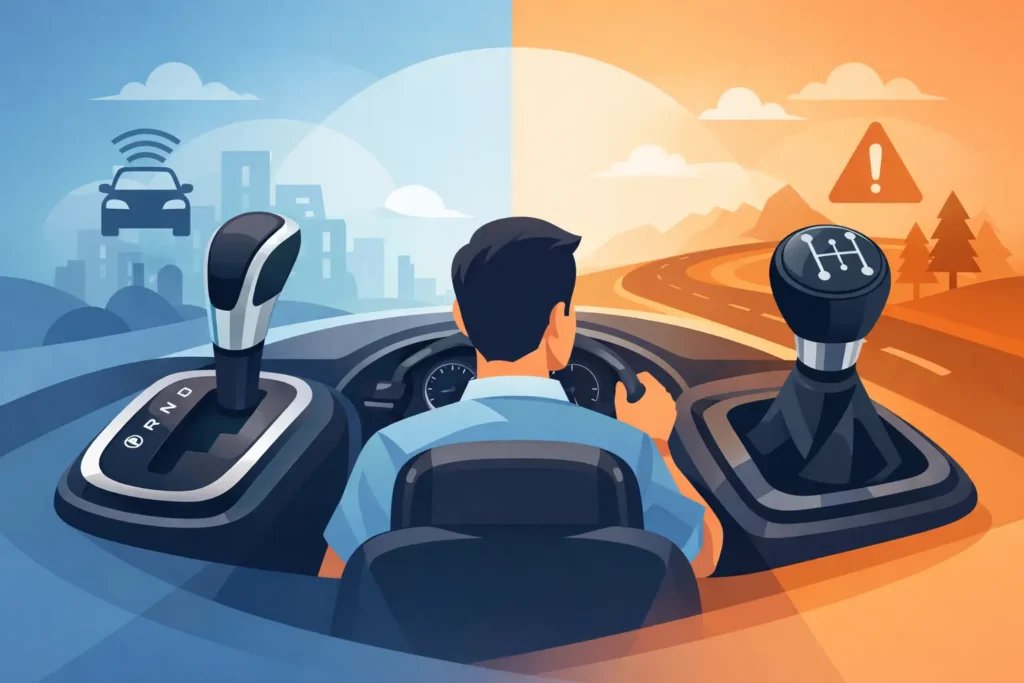
If you learned on an automatic, getting behind the wheel of a manual can seem simple at first: the signs, the mirrors and the rules are all the same. Yet the question “can you drive a manual with an automatic licence?” has two answers. Technically, a manual requires a separate skill. Legally, it depends on which code is on your licence.

The choice between a manual and an automatic does not only decide how you change gear in a lesson. It also affects which cars you are allowed to drive once you have your licence. The right choice depends on your goal, your everyday needs, and the pace at which you want to learn.

Can you drive a manual if you already hold a licence?

If the category B driving test was taken in a car with an automatic gearbox, restriction code 78 is usually added to the licence. That means the entitlement applies to vehicles with an automatic gearbox. You may not drive a manual car in traffic with such a licence, even if you know in theory where the clutch and the gear lever are.

The restriction is not a punishment or a judgement on your driving. It simply shows which gearbox your skill was demonstrated on at the state exam. A driver who passed on an automatic may be very attentive, safe and confident in traffic. Driving a manual, however, adds one separate task: controlling the clutch, the gear and the engine’s torque.

The situation is reversed if you take the category B test in a manual car. In that case no automatic restriction is added, and you may drive both manual and automatic cars. That is why some learners choose a manual precisely for the widest possible freedom of choice.

Why knowing how to drive an automatic is not enough on its own

In an automatic, the car selects the gear itself. More of the driver’s attention is left for watching the traffic, regulating speed, keeping a distance and steering smoothly. For many beginners that is a real advantage, especially in dense Tallinn traffic or when they arrive at a lesson after a long working day.

A manual adds the work of the left foot on the clutch pedal. Pulling away, you have to find the biting point, give a suitable amount of accelerator and release the clutch in a controlled way. Until these actions have become habit, the car may stall, jerk, or roll back too quickly on a slope.

Changing gear also calls for anticipation. Before a turn, a roundabout, a hill or slowing down, you have to select the right gear. For an experienced driver this happens almost automatically; for a beginner it takes conscious attention. That is exactly why an automatic-only entitlement should not be treated as permission to try a manual on your own in traffic.

At the same time, someone who learned on an automatic has no reason to fear a manual. Reading traffic, where to direct your gaze, using the mirrors, keeping a safe side gap and deciding calmly all carry over from one car to another. What has to be learned is mainly the technical handling of the car, not traffic from scratch.

How to remove the automatic restriction from your licence

If you hold a category B licence obtained on an automatic and later want to drive a manual, you have to demonstrate your skill in a manual car. In practice that means at least two additional driving lessons in a manual car at our school and taking a new practical driving exam at the Transport Administration. There is no need to retake the theory exam. After passing, the automatic restriction can be removed from the licence.

Before registering for the exam, check the current requirements and the documents you need. The rules can change over time, and your earlier training, licence details and the planned exam all have to be filed correctly. A driving school can help judge how much practice you actually need, and prepare you for the situations where manual drivers most often go wrong.

Many automatic drivers do not need a long beginners’ course. If you already cope in traffic, the extra lessons can concentrate on the clutch, gear changes, pulling away and driving on hills. The number of lessons depends on the person. Some pick up the basics quickly; others need more time before gear changes stop taking attention away from the road.

Start calmly, with the basics

Learning a manual should start somewhere with little traffic, where the consequences of a mistake are small. First you practise the seating position, the feel of the pedals and a smooth pull-away. Then come braking, changing down, reversing and parking.

Practising a hill start builds a great deal of confidence. The aim is not to do it as fast as possible, but to understand how the car behaves and to stay in control. Once you have found the biting point and your feet no longer require tense concentration, your attention can return to watching the traffic.

Practise the situations you actually need

With a manual, exercises on an empty area are not enough. In city traffic you have to change gear around traffic lights, crossings, junctions and other road users. On the open road you have to choose a gear to suit the speed and plan an overtake or an acceleration at the right moment.

A good instructor does not only say when to change gear. They explain why one gear is better than another in a particular situation, and how the sound, the speed and the engine’s behaviour give the driver feedback. That is how a lasting skill develops, rather than a memorised sequence of actions.

Should you choose an automatic or a manual from the start?

An automatic is a sensible choice if you want to get your licence with as much focus as possible and without the extra load of the clutch. It also suits you well if you already know that the family car or company car is an automatic and you have no real need for a manual. The share of automatic cars keeps growing, and electric cars have no conventional gear changing at all.

A manual may be the better choice if you want to keep every option open. In future you may need an older rental car, a friend’s car, an employer’s vehicle or a cheaper second-hand model. Learning on a manual takes more practice at the start, but gives you broader entitlements on your licence.

Do not decide simply on which seems harder. Ask yourself which car you will be driving over the next couple of years, how quickly you want to reach your licence, and how much time you can give to lessons. If you have a fear of driving or have failed an exam before, an automatic can help reduce the number of tasks to be handled at once. That does not mean less responsibility – watching the traffic and deciding safely always remain the driver’s job.

Three common questions

Can someone with an automatic licence practise in a manual?

Training drives take place under the conditions set out in law and with the appropriate supervision. You may not drive a manual car in traffic on your own with a restricted licence. The safest way is to practise beside an instructor, where you get a clear instruction and help the moment you need it.

Is the exam significantly harder in a manual?

In both cases the exam assesses safe driving above all. With a manual, handling the car is added, so there may be more tension at the start. With enough practice the clutch and the gear changes become ordinary, and in the exam you can concentrate on what counts most: calm, attentive and anticipatory driving.

How quickly can you move from an automatic to a manual?

There is no single number. If your traffic skills are fresh and your automatic driving is already solid, progress can be quick. If you hold a licence but have little driving experience, it is worth taking more lessons and building the skill calmly. Rushing tends to leave gear changes shaky in exactly the more demanding situations.

Driving a manual is a skill to be learned, not an inborn talent. If your goal is more freedom of choice, start with supervised practice, learn to understand how the car behaves, and give yourself time. Autokool Kindel Rool helps you choose a pace that matches your experience, so that the next step behind the wheel is a confident one – in the exam and in real traffic alike.

Kuidas parkida rööpselt eksamil kindlalt

How to Parallel Park Confidently on the Driving Test

Parallel parking does not fail the driving test because a learner cannot turn the wheel. Usually, under pressure, what slips is the observation, the judgement of where the car is, or a calm decision. If you know how to parallel park on the test in a fixed order, it is not a trick or a gamble but a controllable technique.

The examiner is not expecting perfect parking in a single movement. They assess whether you choose a suitable space, watch the traffic, check your surroundings and position the car safely. A small correction is entirely normal, as long as you make it calmly and keep observing.

What is actually assessed in parallel parking?

Parallel parking is a good exam exercise because several important skills meet in it at once: controlling the car at low speed, using the mirrors, checking the blind spots, judging space and allowing for other road users. The aim is not to prove you remember one particular formula for turning the wheel. The aim is to show you can control the car in a confined space without creating danger.

The examiner looks above all at whether your actions are safe and well-reasoned. Before the manoeuvre it must be clear that the space is big enough and that entering it does not obstruct traffic unnecessarily. While reversing you have to watch both the mirrors and the direction the car is moving in. Relying on the reversing camera alone is not enough, because the camera does not show everything around you.

The final position matters too. The car should end up as parallel to the kerb as possible and must not stick out into the carriageway. The gap from the kerb should be sensible – too close risks the wheel rim or the tyre, too far and you obstruct traffic. If the car is at an angle after the first attempt, correct it. On the test, a considered correction counts for more than a hopeless final position reached in a hurry.

How to parallel park, step by step

Choose the space and prepare the manoeuvre

If the examiner asks you to parallel park where possible, do not take the first gap you see. Judge it as you approach. The space has to be clearly longer than your car, especially while you are still learning. Squeezing into a tight gap does not show courage; it forces abrupt and unsafe movements.

Signal right in good time. Check the interior mirror, the right-hand mirror and the right blind spot. Then pull up alongside the car in front of the space. The side gap should be roughly half a metre to a metre, depending on the width of the road and the situation. Too close and it is hard to swing the nose clear while reversing; starting too far out and the car ends up a long way from the kerb.

Stop so that the rear of your car is more or less level with the rear of the car beside you. The exact reference points depend on the car, your seating position and how the mirrors are set. That is why you should not follow blindly on the test a tip picked up from a friend, along the lines of “turn when the tail light is in the middle of the window”. Work out with your instructor what you see from your own seat.

Start reversing slowly and with observation

Select reverse and, before moving, check the blind spot and the area behind you once more. Reverse very slowly. In an automatic, controlling the speed with the brake helps; in a manual, smooth use of the clutch. The speed has to let you see, think and stop if you need to.

The first turn of the wheel brings the rear of the car closer to the space. The wheel is usually turned right once the rear has reached a suitable point relative to the car in front. Keep your gaze moving: look behind, check the right mirror, and watch the left mirror when needed. Steering and observation go together, not first turning the wheel and only then looking at what is happening around you.

When the rear is heading towards the kerb and the car is at roughly 45 degrees to the road, start steering the other way. That brings the nose into the space. This is where people rush most often: the wheel is straightened too early or too late, and the car ends up crooked. Do not try to rescue this with the accelerator. Stop, judge the position and correct with small movements.

Straighten the car and check the final position

Once the car is almost parallel to the kerb, straighten the wheels. Check the distance to the kerb in the right-hand mirror while making sure there is enough room front and rear for other cars. Parking should not involve touching the kerb or other vehicles. A touch usually means the speed was too high, or that you relied on guesswork instead of observation.

If the final position is not good, make a correction. Pull forward a little, checking your surroundings before moving, and straighten the car. The wheels can be left straight if the situation allows. Unless the examiner says otherwise, finish the manoeuvre calmly: handbrake, the appropriate gear for the type of car, and readiness for the next thing you are asked to do.

Observation matters more than the perfect steering angle

Many learners fear that while reversing they must look over their shoulder the whole time and may no longer use the mirrors. In fact you need both. Looking in the direction of travel gives the most direct information about the area behind the car, while the mirrors help you judge the side gap, the kerb and the car’s position. Your gaze has to move deliberately, not lock onto one point.

If a pedestrian, a cyclist or another vehicle approaches during the manoeuvre, stop. Even if you are already halfway into the space, it is not sensible to carry on hoping the other road user will go around you. Stopping shows good risk awareness. The same applies when you cannot see well enough – create the visibility first, then continue.

An indicator does not release you from observing. It tells others what you intend to do, but responsibility for the safety of the manoeuvre stays with the driver. On the test it is worth making your movements slightly slower, but decisively. A long hesitation in the middle of the lane disrupts the traffic flow more than a calmly prepared parking manoeuvre.

Common mistakes and how to prevent them

The most common mistake is starting too fast. If the car rolls back too briskly, the steering corrections become abrupt and the observation falls behind. Practise slow rolling until you can control the car without adding any accelerator at all.

The second frequent problem is focusing too much on the kerb. The learner watches only the right-hand mirror so as not to hit the stone, and misses someone approaching from behind or the nose swinging towards the car in front. Keep the whole circle of observation working.

The third mistake is believing that parking has to succeed in one go. Real streets do not always offer an ideal space, the road may be on a slope, and the cars beside you may be of different lengths. A correction is not a failure. The risk of failing grows when you leave the car in an unsuitable position, or correct without checking your surroundings.

Practise in different places, not by one landmark

Parallel parking becomes solid when you practise it on different streets, in spaces of different lengths and at different traffic densities. On an empty area you learn the relationship between the wheel and the car’s movement. On a real street you add the indicator, judging traffic, pedestrians and the need to decide under time pressure.

A good instructor helps you find reference points that work for you, but also teaches you to let go of them when necessary. At Autokool Kindel Rool we work from the principle that an exam technique has to keep working after you have your licence – when the space is tighter, the weather worse, and nobody beside you says when to turn the wheel.

Before the test it is worth practising exactly what makes you uncertain. Do you start too far out? Do you tend to straighten the wheel too early? Does the blind-spot check slip your mind when you are thinking about the gears? The general principles of passing the driving test help here too. Specific feedback is worth far more than ten mechanical repetitions.

If the space looks awkward at first on the test, take a moment to size it up. Breathe, prepare the manoeuvre and trust the order you have practised. Calm observation, slow movement and a correction where needed will carry you much further than the wish to show you can do it with one quick turn of the wheel.

Scroll to Top