Driving lessons

Sõiduhirmu ületamine autokoolis rahulikult

Overcoming a Fear of Driving at Driving School

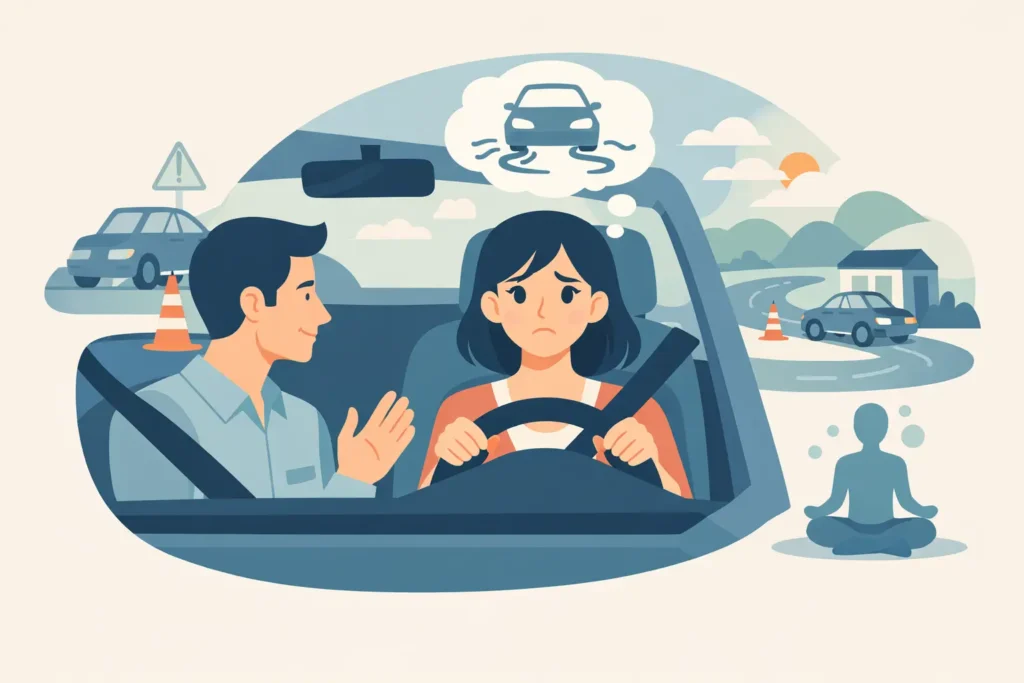
Your first time in dense Tallinn traffic can feel like too much at once: mirrors, gears, pedestrians, traffic lights, a bus moving in the next lane, and an instructor calmly saying that you turn right at the next junction. Overcoming a fear of driving at driving school does not mean the discomfort has to disappear in the very first lesson. It means learning to act alongside the fear, so that every drive adds control rather than tension.

A fear of driving does not show that you could not become a good driver. Often it shows the opposite: that you take the responsibility seriously. With the right guidance, enough practice and a clear plan, that initial anxiety turns into the ability to read traffic, make decisions and drive independently.

Why does a fear of driving arise?

Driving requires several new actions at once in the beginning. In a manual you have to feel the clutch and choose a gear; in an automatic you can focus on the traffic sooner. In both cases you have to learn to look well ahead, keep your distance, judge the intentions of other road users and make decisions under time pressure.

Fear is often amplified by the wish to do everything flawlessly. The learner is afraid the car will stall at a junction, that they will miss a sign, or get in the way of drivers behind. In reality, a lesson is exactly the place to experience those situations safely. The instructor’s job is not to wait for a perfect performance, but to help you understand what happened, why it happened, and what to do differently next time.

For some people the anxiety has a specific cause: an unpleasant lesson in the past, a failed exam, witnessing a crash, or a long break after getting a licence. In that case “don’t be afraid” is not enough. What is needed is a calm pace and exercises that restore trust in your own decisions.

Overcoming the fear starts with a suitable pace

Not everyone starts from the same level. One learner has already driven on the open road with a parent; another sits behind the wheel for the first time. Training therefore has to move from simpler to harder, not the other way round. The first lessons can focus on the feel of the car, smooth braking, turning and calm driving on quieter streets.

Once the basics become familiar, junctions, roundabouts, parking, denser city traffic and higher speeds are added. This gradual build-up matters, because confidence does not come from simply covering more kilometres. It comes from the experience of coping with an increasingly demanding situation.

Pace does not mean dragging things out indefinitely, though. Too long a gap between lessons can increase anxiety, because each time you have to start again as if from scratch. A regular rhythm suits many people — one or two lessons a week. Evening and weekend slots help keep that rhythm alongside work or studies.

Tell your instructor what actually troubles you

At the start of a lesson it is worth saying directly if you are afraid of, say, left turns, lane changes, parking or joining a main road. That is not weakness and not an excuse. The more precisely your instructor knows where the tension sits, the more purposefully the lesson can be built.

Good feedback is specific. Instead of only hearing “be more attentive”, a learner should understand where to direct their gaze, when to reduce speed, and which sign or situation the decision follows from. For a lane change, a clear order of actions helps: check the mirrors, signal, check the blind spot, choose the right moment and move across calmly. When the action is broken into small steps, the brain does not have to solve everything at once.

Constructive guidance does not mean mistakes go uncorrected. On the contrary, they should be discussed immediately and clearly. But a mistake should not turn into a label along the lines of “you can’t do this”. It is one situation, one cause, and the next chance to practise the same technique better.

Practise the situation that frightens you, deliberately

Avoidance brings relief for a moment but keeps the fear alive. If roundabouts create tension, you do not have to take the most complex one at rush hour on your first attempt. You can start at a quieter time and with a simpler layout. Once the principle is clear, you can move step by step to more demanding situations.

The same goes for parking. A fear of parking does not disappear from doing the exercise once before the exam. Repetition teaches you to notice the car’s position, use the mirrors and correct calmly. In real traffic the aim is not to park in a single movement. The aim is to complete the manoeuvre safely, stop if needed, reassess and adjust.

If the fear is tied to the exam, it is worth practising exam-style drives as well. That means more independent decisions, different types of road, and situations where the instructor does not prompt every step. It becomes clearer which skills are already solid and which still need repeating. The exam does not have to be a leap into the unknown — it is a chance to show what you have consistently practised.

Simple ways to help yourself when anxiety rises

While driving, there is no need to fight the anxiety or pretend it is not there. Notice it and bring your attention back to the task. Before setting off, adjust the seat, mirrors and steering wheel so that your body is comfortable. A drive started in a rush raises the tension before the first junction.

If you feel your thoughts sliding into panic, use a short internal plan: I look ahead, I check my speed, I keep my distance. That directs your attention to what you can do right now, rather than to what might go wrong.

It also helps to note down, after a lesson, one thing that went well and one situation you want to practise next time. Under fear, the brain tends to remember only the mistakes. Noticing concrete successes gives a truer picture of your progress.

Manual or automatic: choose what suits your learning

The choice of gearbox can noticeably affect your confidence. A manual gives you more technical skill and a category B licence that lets you drive both manual and automatic cars. It does, however, demand more attention at the start for the clutch, the gear changes and a smooth pull-away.

An automatic reduces the technical load, and many anxious learners can turn to reading traffic sooner. That choice comes with a restriction on the licence to automatic vehicles. The right choice is not decided by other people’s opinions, but by your real needs, your future car and the goal of your training.

When a past experience has knocked your confidence

A failed driving test does not prove you are unsuited to driving. The result can be affected by nerves, the unfamiliar exam setting, one difficult junction, or a skill that was not yet automatic enough. It is important to avoid two extremes: going straight back to the exam without analysing the cause, but equally not waiting a long time out of fear.

Further training makes sense when you need specific support before a new exam, or want to cope more confidently in traffic on your own after getting your licence. Sometimes a few targeted lessons are enough; other times a person needs more time. It depends on whether the issue is a single manoeuvre, applying the rules, or broader anxiety.

Autokool Kindel Rool’s category B training is built on exactly this principle: teaching has to develop real traffic skill, not only a feel for the exam route. Calm, individual guidance and regular practice let a learner move from a weakness to the next strength.

In your next lesson you do not have to prove that you are fearless. It is enough to be ready to make one more considered decision than last time. That is how confidence behind the wheel grows — the kind that stays with you long after you have your licence.

Millal aitab jätkuõpe enne sõidueksamit Tallinnas?

When Further Training Helps Before the Driving Test

The test date is booked, but every lesson brings up a new uncertainty: one time a crossing goes unnoticed, the next a rushed parking manoeuvre goes wrong. Further training before the driving test in Tallinn is designed for exactly this stage – when the basic techniques are there, but the confidence you need for the exam is not yet steady.

Further training is not a sign that someone is unsuited to driving. Quite the opposite: it is a deliberate decision to check your skills honestly before the state exam, work through the weak spots, and do it at a calm pace. The goal is not to memorise one particular route. The goal is to be able to notice, decide and act even when the situation changes.

When is further training before the test actually needed?

The most common reason is the feeling that driving only works when a familiar instructor is sitting beside you and the road is already known. On the test there is no such support: the traffic is real, instructions may come at the last moment, and your attention has to cover signs, pedestrians, speed and handling the car all at once.

Further training suits a learner who has had a break from driving, changed driving school, or wants to practise with a different instructor before the test. A fresh pair of eyes often spots habits that went unnoticed in earlier lessons. A driver may consistently stop too far forward at junctions, brake late, or choose a lane at the very last moment.

Extra lessons are also justified after a failed test. In that situation, do not assume automatically that dozens of new hours are needed. Sometimes a few precisely aimed drives are enough to restore your rhythm and fix the specific gap the test revealed. Other times the result shows that several linked skills need attention – observation, choice of speed and getting through junctions. Then a more thorough plan is worth making.

Anxiety is a perfectly valid reason to come to further training too. Nerves do not disappear on command, but a firm order of actions helps you manage them. If you know how to check your surroundings before a manoeuvre, when to ease off the speed, and how to deal calmly with a small mistake during the test, one tense moment will not define the whole drive.

Tallinn traffic puts your skills to the test

Driving in Tallinn means much more than keeping the car straight. Dense traffic, junctions of varying layouts, public transport lanes, cyclists, crossings and changing speed limits all demand that you keep reading the situation. The examiner is not looking for perfect, robotic driving. They assess whether the driver makes safe, timely and independent decisions.

A great many mistakes come from rushing. The learner sees where they need to turn but does not notice the lane markings or a sign early enough. Then they try to rescue the situation with an abrupt lane change, late braking or a hesitant turn. Further training practises driving ahead of the situation: your gaze moves further, the necessary decisions come earlier, and manoeuvres become calmer.

The other important theme is allowing for other road users. On Tallinn’s streets not everyone moves with ideal gaps and at an even pace. A safe driver has to anticipate possible risks: a child may step towards the crossing, a bus may pull out of its stop, a car in the next lane may want to move in front of you. That skill is built through considered repetition, not by memorising the rules alone.

What actually happens in good further training?

Effective further training starts with an assessment of your driving, not with a ready-made package. The instructor watches how you handle the car, where your attention goes, and in which situations your decisions become uncertain. Only then can a realistic plan be set.

For one learner, parking and reversing will be at the centre. For another, the manoeuvres are technically fine but observation at junctions is too sparse. A third drives well in general but loses composure in demanding traffic and starts to rush. Offering everyone the same programme would be convenient, but it would not produce the best result.

In practice it is worth focusing on situations that require several skills at once. A left turn at a large junction calls for the right lane choice, watching the signs, judging oncoming traffic, noticing pedestrians and controlling speed smoothly. Once a situation like that becomes clear, confidence grows in many other situations too.

It matters that feedback after a demanding spot does not stop at “be more attentive”. Good guidance says exactly what to change: where to direct your gaze, when to start braking, which sign went unnoticed, and what action would have created more time to decide. Specific feedback gives the learner a way to do better next time.

How many extra lessons do you need?

The honest answer is: it depends. If the skill is there and all you need is a pre-exam check and some confidence, a few lessons may be enough. If the break from driving has been long, the same problems keep recurring in the test, or handling the car takes up a large share of your attention, planning more practice makes better sense.

The number of lessons is not a goal in itself. A sensible measure is whether you can explain independently, in different traffic situations, what you see, what risk you are judging and why you are acting as you are. If the decisions come calmly and the instructor does not have to prompt them, your exam readiness is far stronger.

In a manual car, the smoothness of the clutch and gear selection may need extra attention, especially when pulling away on a hill and in dense city traffic. An automatic reduces the technical load but does not make reading traffic any easier. In both cases the same principle is assessed: the driver must control the vehicle and behave safely and independently in traffic.

The test drive is not a performance

On the test, people sometimes try to control every movement. They grip the wheel too tightly, check the mirrors demonstratively, or drive unreasonably slowly out of fear of making a mistake. In reality the best test drive is natural and attentive. Mirrors are checked as needed, the speed is chosen to suit conditions, and decisions are made clearly.

A small imperfection does not necessarily mean failure. If the parking needs correcting, do it calmly while watching your surroundings. If an instruction about a turn was unclear, it is sensible to ask for clarification rather than making a risky manoeuvre on a guess. Further training helps you think such situations through before the exam, so that no panic arises in the tense moment.

At Kindel Rool, the first-attempt success rate of our category B learners in Tallinn has been 1.43 times higher than the Tallinn average. That does not mean a result can be promised to anyone. What it does show is how much systematic preparation, individual feedback and practice aimed at real traffic actually matter.

How to choose the right further training

Before booking extra lessons, ask whether the instructor first assesses your level and gives clear feedback after the drive. The scheduling has to fit your real life too. Evening and weekend slots are especially valuable when work, studies or family leave no room during the day.

A good instructor does not leave you feeling that every mistake proves you are unfit to drive. They go straight to the cause, explain it, and give you the chance to try the same situation again. A calm atmosphere does not mean lowering the standards. It means high standards are practised in a way that actually helps the learner improve.

As the test approaches, do not only ask yourself whether you can drive the test route. Ask whether you can spot a hazard before it becomes a problem, and make a decision when nobody beside you is guiding any more. That is where confident driving begins – in the exam and on every drive after it.

How to get the most out of a short course

The value of an intensive course depends largely on how precisely the lesson time is used. At the start of the first lesson, tell your instructor directly what worries you. Did it go wrong before with lane changes, parking, left turns – or was it nerves? Is driving an automatic solid, while the clutch and gear selection on a manual are not yet? A specific starting point makes a specific plan possible.

Do not try to fix everything in one drive. If there is a lot of feedback, choose one or two main points of focus after each lesson. For instance, next time you pay particular attention to the mirrors and to your choice of speed. Once those start to come naturally, move on to more demanding junctions or manoeuvres.

It helps to write down a couple of sentences after a lesson about what went well and what needs repeating. It does not have to be a long diary. A note such as “before a lane change I always check the mirror and the blind spot” or “approaching a junction I ease off the accelerator earlier” makes it quick to recall the main point next time.

If you also drive with a private supervisor, agree that you will practise the same principles. Contradictory advice can only increase pre-exam nerves. A learner needs a clear system: safety first, then smooth progress and well-reasoned decisions.

Õhtused sõidutunnid Tallinnas - kas need sobivad?

Evening and Weekend Driving Lessons in Tallinn

Traffic in Tallinn is far from quiet once the working day ends. The worst of the rush hour may be over, but the streets still hold public transport, pedestrians, scooters, dimly lit crossings and drivers who want to get home quickly. That is exactly why evening driving lessons in Tallinn are not merely convenient for someone with a full diary. They are a chance to learn in the conditions you are most likely to meet as a driver.

Many licence candidates put driving school off because daytime slots do not fit around work, university, an internship or family life. In reality, getting a licence does not have to mean putting the rest of your life on hold for months. Well-planned evening lessons let you learn consistently and gather experience both in daylight and in the dark.

Why choose evening driving lessons in Tallinn?

The biggest advantage of an evening lesson is often simple: it fits into real life. If your working day ends at five or six, you can take a lesson straight afterwards without missing a lecture or using time off. It is true that instructors are people too, so a free evening slot can sometimes be harder to find. With early planning and a shared agreement, though, it is perfectly possible. Consistency matters enormously for driving skill: one well-focused lesson a week usually achieves more than occasional long drives.

Evenings in Tallinn also offer genuinely valuable experience. The traffic is not necessarily sparse, but its rhythm differs from the morning or midday. You get used to judging visibility, checking the mirrors more often, spotting a pedestrian before the crossing, and choosing your speed to suit the road surface and the lighting. These are not exam exercises; they are skills that later help you make safer decisions on your own.

An evening lesson suits a learner who wants time to settle. During the day, a driving lesson can feel like one more obligation in a packed calendar. In the evening you can give your attention to a single task: driving. That said, after a long day at work or school the mind is often tired, so completely new skills and topics are ideally taken on during the day, when your head is fresh. If your concentration tends to drop in the evening, an earlier slot, the weekend, or a mix of times may work better.

Evening traffic teaches real situations

For a beginner, the darker hours can feel uncomfortable at first. Signs, lanes and other road users do not look the way they do at midday. In a guided setting, though, that is a valuable learning moment. Your instructor helps you notice where to direct your gaze, when to reduce speed, and how to keep a sufficient gap.

Three habits become especially important when driving in the evening: consciously scanning your field of view, choosing speed smoothly, and acting early. It is not good practice, for example, to brake only once the person at the crossing is clearly lit by your headlights. A safe driver notices movement on the pavement, lifts off the accelerator and is ready to stop.

In Tallinn, tram tracks, bus lanes, multi-lane junctions and demanding lane changes are added to all of this. In the evening, wet asphalt reflects the lights and a road sign may need a more careful look. A learner does not have to do everything perfectly straight away. The aim is to understand why a situation became difficult, and to try a deliberately better solution next time.

Is driving easier or harder in the evening?

It depends on the hour, the season and the district. In summer, seven in the evening can still be fully light; in winter it is already dark. In the city centre and on the larger main roads traffic stays active, while residential areas are calmer. An evening lesson is not automatically easier or harder – it simply offers a different experience.

For a complete beginner it makes sense to do the first drives in daylight and at a calmer hour, so you can focus on the feel of the car, the clutch or the automatic gearbox, and the steering. Once the basics are familiar, evening driving broadens the skill. Equally, a calm and patient instructor can work successfully with a beginner in the evening, provided the route and the level of difficulty are chosen to match.

How to prepare for an evening lesson

An evening drive really begins before you get into the car. If you are coming straight from work or a lecture, give yourself a couple of minutes to switch over. Check that your phone is on silent, that your clothing lets you work the pedals freely, and that you are not in a hurry to be somewhere next. Rushing carries over behind the wheel very easily.

If you are tired, say so honestly. Being tired does not mean the lesson has to be cancelled, but it does mean a more suitable pace can be chosen. Perhaps this time you will focus on parking, on junctions, or on one route, rather than several demanding new skills at once. Good training is not built on pushing the learner to maximum load every time. It is built on the right challenge at the right moment.

In the darker months, the practical details matter too. Clean glasses, if you wear them, reduce the glare from oncoming lights. Comfortable shoes give you a feel for the pedals. And before setting off, take a moment for your seating position, the mirrors and the lights. These small actions build a routine that stays with you long after you have your licence.

Evening lessons are not only exam preparation

The state driving test checks whether you can act independently and safely in traffic. It is worth remembering, though, that official exams take place during the day, when traffic is busy, not late in the evening when the streets are empty. So it is not enough to memorise the turns in the test area or learn one parking exercise by heart. Real confidence comes when you can apply the same principle in a new place, in worse weather and on a busier street.

Evening lessons are exactly where that transfer can be practised. If a roundabout you learned in daylight feels different in the dark, it does not mean the skill has gone. It means your brain is learning to adapt the same technique to new conditions. That experience later reduces the situations where a newly licensed driver feels safe only on a familiar route.

At Autokool Kindel Rool we work from the principle that a learner needs clear feedback, not merely a verdict. If a lane change came late or the speed at a junction was too high, it matters to understand why. Did your gaze stay too long on the road right ahead? Was the sign noticed late? Was the decision made in a hurry? Once the cause is clear, you can make a deliberately better choice next time.

This approach also supports the exam result. Our category B learners in Tallinn pass the driving test on the first attempt 1.43 times more often than the Tallinn average. The number matters, but what it reflects matters more: systematic practice, individual guidance, and the ability to drive when conditions are less than ideal.

Who suits evening lessons best?

Evenings are a natural choice for people in work, for students and for parents whose daytime hours are already spoken for. They also suit a learner who wants more city traffic experience and confidence driving in the dark. The same principle applies to manual and automatic training: the gearbox affects what takes most of your attention at the start, but reading traffic, choosing a safe speed and allowing for others are needed either way.

If you have a fear of driving, or your last test attempt did not go well, an evening lesson can be a good way to start with small, clear goals. Not “I have to be able to do everything today”, but for instance “I am practising a calm approach to junctions” or “I am learning to prepare a lane change earlier”. Every successful repetition builds trust in yourself.

Free time in the calendar is valuable, but the skill that gives you more freedom of movement afterwards is more valuable still. Choose a lesson time when you can be present both physically and mentally. Then every evening drive becomes a step towards driving independently, safely and with confidence.

Why choose weekend driving lessons in Tallinn?

For many learners the biggest obstacle is not a lack of motivation but the calendar. Full-time work, lectures, shift work or family commitments can make a weekday lesson difficult. When a lesson keeps falling through, or the whole day has to be rearranged around it, the rhythm of learning suffers. Weekend slots help build a firm habit: one or two drives every week at the same time.

This suits a learner who wants to be present in the lesson with both attention and thought. After a long working day, getting behind the wheel may feel possible, but tiredness affects reactions, judgement and how well new information is retained. On a Saturday or Sunday morning it is often easier to follow instructions, notice road signs, and work out why something went well or why it still needs practice.

That said, the weekend does not automatically mean lighter traffic. It depends on the hour and the district. Early in the morning there may be fewer cars in the centre, but later come shoppers, pedestrians, event visitors and tourists. Good training uses that difference deliberately: a beginner first builds confidence at a calmer pace, while a more advanced learner practises in denser traffic on purpose.

Does the weekend suit a learner with driving anxiety?

Yes, often very well. Anxiety does not mean a person cannot become a good driver. Usually it means situations need to be taken in smaller steps, and the learner needs to feel safe asking, making mistakes and trying again. At the weekend it is easier to choose an hour when the roads are not at their busiest.

Even so, it is important to avoid staying in the comfort zone indefinitely. If you only ever drive on empty streets, the next step – denser traffic or the state driving test – will feel too abrupt. A calm instructor raises the difficulty gradually: first a familiar route, then new junctions, then more demanding traffic. Each time you need to understand not only what to do, but why.

At Autokool Kindel Rool we teach on the principle that driving skill has to hold up both in the exam and in independent traffic. A result like that does not come from exam tricks, but from systematic practice, individual feedback, and the ability to correct mistakes before they turn into habits.

When the weekend may not be the best option

If what you need is rush-hour experience, a Saturday morning will not always replace a weekday evening. Weekday traffic in Tallinn is a learning environment of its own: more vehicles, more lane changing and less time to decide. When preparing for the exam it makes sense to experience different times of day rather than sticking to one comfortable window.

It can also be harder to keep a regular rhythm at weekends if your plans change often. If Saturdays fill up with sport, family events or work, a fixed weekday evening may actually be more stable. The best study plan is not the one that sounds flexible, but the one you can genuinely stick to.

Automaatkäigukastiga sõiduõpe Tallinnas

Automatic Driving Lessons in Tallinn

In Tallinn’s rush hour, the biggest challenge for a beginner is not always the clutch. Far more attention usually goes to bus lanes, pedestrians, trams, multi-lane junctions and a traffic flow that keeps changing. Learning to drive an automatic in Tallinn lets you concentrate on what actually makes a driver safe: observation, choosing the right speed, allowing for others and making calm decisions.

Learning on an automatic is not about looking for an easy way out. It is a deliberate choice for someone whose everyday car is an automatic, who has a packed schedule, or who wants to get the most out of each lesson without constantly thinking about the mechanics of changing gear. Proper training still means far more than using the accelerator and the brake. The goal is to drive confidently even when traffic does not behave predictably.

What learning on an automatic in Tallinn actually teaches

An automatic gearbox removes one task from the driver, but it does not reduce the number of skills traffic demands. In the very first lessons you learn to sit correctly, adjust the mirrors, signal at the right moment and judge where the car actually fits on the street. These details form the base on which more complex manoeuvres and independent driving are built.

Driving in Tallinn gives you very good practical experience. A learner meets roundabouts, public transport, uncontrolled crossings, narrow side streets and larger main roads. A lesson should not be limited to practising parking on a quiet street. Parking matters, but so does being able to merge safely, choose the right lane at a junction, and stay calm when the traffic behind you seems impatient.

A good instructor helps you see cause and effect in every exercise. A late indicator, for example, is not simply an exam mistake. It leaves other road users too little time to understand what you intend to do. In the same way, a hesitant lane change is not just a nervous moment but a situation you can prevent with early observation, use of the mirrors, and decisive yet smooth action.

Who is automatic training right for?

Learning on an automatic suits someone who plans to drive an automatic after getting their licence. In Tallinn that is a very practical choice, because automatic cars are common both in families and as company cars. In city traffic, where you constantly stop and pull away again, an automatic lets you keep more attention on the road.

This option also suits a learner with driving anxiety or an unpleasant earlier experience of a manual. For some people, coordinating the clutch and the gear changes takes up so much attention that less is left for road signs, pedestrians and observation. With an automatic you can start more calmly and build confidence step by step.

Even so, it is worth looking beyond the exam when you decide. If you know that in future you may need to drive a manual company car or a family member’s car, or you want the widest possible freedom, a manual may suit you better. A licence obtained on an automatic entitles you to drive automatic vehicles. The manual entitlement can be added later, but that means further training and another exam.

The choice does not have to rest on other people’s opinions. The sensible question is: which car will you actually be driving, and in which form of training will you build the most confident behaviour in traffic?

What the path from the first lesson to the exam looks like

Training usually starts by getting to know the car and its controls. In an automatic, the selector normally has P, R, N and D positions, but knowing what they mean is not enough on its own. You learn when it is safe to start the car, how to pull away, how to brake smoothly, and why you should look in more than one mirror before every manoeuvre.

From there the training moves steadily towards real traffic. Quieter streets are right at the beginning, because they let you get a feel for the car and practise the basic observation routine. Then come larger junctions, merging, roundabouts, reversing and parking. Once the basics are in place, you practise situations that call for independent judgement: when to give way, how to spot a hazard early, and when it is wiser to postpone a manoeuvre.

Theory and driving lessons should support each other. E-learning lets you study the rules when it suits you, but theory only becomes a lasting skill in the car. Once you have studied priority rules, your instructor can help you see at a real junction where a hazard might come from and which signs need to be read together.

Preparing for the exam does not mean memorising one particular route. The exam assesses whether your driving is safe, smooth and independent. That means being able to make the right decisions in an unfamiliar place too. In the final stage it is useful to take on exactly those situations that create the most tension – demanding roundabouts, parking in a dense city environment, or choosing your speed in changing conditions.

Why individual feedback counts for more than the number of lessons

Two learners can have the same number of lessons and completely different readiness. One needs more practice with lane changes, another tends to rush at junctions, a third does not trust themselves when parking. Simply accumulating hours does not break those patterns. What produces results is an instructor noticing the weakness, explaining what causes it, and giving you the chance to practise the skill safely and repeatedly.

Constructive feedback does not mean tense silence or reproach after every mistake. A beginner makes mistakes – that is a natural part of learning. What matters is understanding what happened and what to do differently next time. If a lane change was left unfinished, the cause may be looking in the mirror too late. If the car stops too abruptly before a crossing, the situation was probably noticed too late. Once the cause is clear, it becomes possible to fix it.

At Autokool Kindel Rool we work from the principle that a skill has to function outside the exam as well. For our category B learners in Tallinn, the chance of passing the exam on the first attempt is, according to the school’s own data, 1.43 times higher than the Tallinn average. That result does not come from exam tricks, but from consistent practice, calm instruction and attention to what each learner actually needs.

A flexible schedule keeps your learning moving

Many licence candidates fit their training around work, studies or family life. If lessons are hard to squeeze into the middle of a working day, the gaps between them stretch out. A long break often means part of what you learned earlier has to be recovered in the next lesson.

Evening and weekend slots help keep the rhythm. Driving at different times of day is especially useful, because traffic in Tallinn is not the same in the morning, at midday and in the evening. Rush hour teaches you to read the flow and decide calmly; quieter times let you focus on precise manoeuvres and parking.

Before choosing a driving school, it is worth asking whether you can choose an automatic car, how flexibly the theory can be completed, and how lessons are scheduled. A free trial lesson is a good way to sense whether the instructor’s way of explaining suits you and whether the car feels safe enough to learn in. For an anxious learner that is often a better first step than deciding on price or a friend’s recommendation alone.

Four signs that you are ready for the exam and for the road

  • You check the mirrors and the blind spot before a manoeuvre out of habit, not to satisfy the instructor.
  • You choose your speed according to visibility, traffic and road conditions, not only according to the posted limit.
  • You recover calmly after a mistake — choosing a new route or postponing a manoeuvre rather than rushing dangerously.
  • You understand how your actions affect other road users, and you signal your intentions in good time.

These skills do not appear after one very good lesson. They are built through repetition, clear explanations and increasingly independent driving. If some part feels hard right now, it does not mean a licence is not for you. It simply shows which skill needs more attention in the lessons ahead.

The most dependable driver is not the one who never makes a mistake, but the one who notices a situation early, decides calmly and learns from every experience. Give yourself time, ask for explanations and practise for real traffic – that way you arrive on exam day with far more than just the wish to hold a licence.

Frequently asked questions: manual vs automatic

We will help you make a sound choice. Ask us: +372 55 44 007.

Which should I choose — a manual or an automatic?

It depends on your lifestyle. An automatic is ideal for Tallinn traffic jams and is the modern standard (new Toyotas and BMWs are barely sold with a manual any more). A manual, however, is a universal skill that can save you up to 50% of the cost when renting a car on holiday.

What are the chances of passing the Transport Administration exam on the first attempt?

The pass rate among our driving school’s learners in Tallinn is 61.9%, which is roughly 1.43 times higher than the city average (42.5%). In other words, investing in good training saves you both time and the cost of retaking the exam.

Are the instructors calm during lessons?

Yes. Our core value is Nordic calm. Shouting is not allowed: we explain things factually and supportively. Our aim is to train drivers we would be happy to share the road with ourselves.

Why is a manual said to be cheaper when travelling?

In popular European destinations (Italy, Greece, Spain) automatic cars are often in short supply. Renting a manual can be 30–50% cheaper, saving you hundreds of euros over a week’s holiday.

I have code 78 (automatic) but want the manual entitlement. What should I do?

It is straightforward. You need to take at least 2 additional driving lessons with us in a manual car and pass a new driving exam at the Transport Administration. There is no need to retake the theory exam.

Kui palju sõidutunde on vaja B-kategooria juhiloaks?

How Many Driving Lessons Do You Need for a Category B Licence?

After the first lesson, most learners ask the same question: how many driving lessons does it actually take to feel confident behind the wheel? The honest answer is not a single number. The law sets a minimum, but a person needs as many lessons as it takes for the skills to hold up in heavy traffic, in changing weather and under exam nerves.

The goal of a category B licence is not to drive one test route without mistakes. The goal is to read situations independently, make calm decisions and control the car safely. Some learners get there quickly, others need more repetition. Both paths are completely normal.

What the law requires

For category B, the national curriculum minimum is generally 28 driving lessons. On top of those come two separate sessions that no amount of city driving can replace: a slippery-road lesson and a lesson driving in the dark. Together that makes 30 driving lessons. In a driving school one lesson usually means 45 minutes, not 60. So when you compare course volumes and prices, always ask how many 45-minute lessons the package actually contains, and where the driving time starts and ends.

The minimum sets a framework for the process; it is not a promise that everyone is exam-ready the moment that volume is complete. In that time you have to practise city driving, manoeuvres, parking, intersections, roundabouts, driving outside built-up areas and the other situations required by the curriculum. If some skills need more consolidation, extra lessons are a sensible investment, not a sign of failure.

Those two lessons are not a formality. On the slippery surface you see for yourself what happens to a car when grip disappears: how much longer the braking distance becomes, and how little the steering wheel can do once a tyre is already sliding. Driving in the dark shows how distances, contrast and the time it takes to notice a pedestrian all change. Both are far better experienced for the first time next to an instructor than alone in a real situation.

Curricula and requirements change over time. Before starting a course, check the current volume for the category you have chosen.

Why the real number differs from person to person

Driving skill grows through practice, but not everyone progresses at the same pace. Earlier experience on a moped or a scooter helps you read traffic. It does not, however, replace the decisions you make in a car: using the mirrors, choosing your speed, sensing the dimensions of the vehicle and controlling the clutch in a manual.

How often you drive matters just as much. If you drive once every two weeks, part of the next lesson goes into recovering what you had already learned. If you can practise regularly, once or twice a week, the skills stay with you and harder topics can be added step by step. For someone who works or studies, a flexible schedule with evening and weekend slots is what makes that possible.

Learning in Tallinn gives you a lot of valuable experience. Dense traffic, trams, bus lanes, multi-lane intersections and changing road layouts teach you to divide your attention. At the same time that environment can feel overwhelming to a beginner. A good instructor does not throw a learner straight into the hardest situation, but raises the difficulty once the previous skills are solid enough.

In the exam, and later on your own, you will not be able to pick only the familiar and comfortable routes.

Manual or automatic: does it change the number of lessons?

It can. With an automatic, more of your attention is free from the start for watching traffic, choosing your direction and making safe decisions. That helps people with a busy schedule, driving anxiety, or a wish to focus first on the logic of city traffic.

A manual gearbox adds the clutch, gear changes and smooth pull-aways. In the first lessons that means less attention is left for the traffic around you. Later the gear changes become automatic, but getting there takes repetition. In return, a licence obtained on a manual lets you drive both manual and automatic cars.

Do not choose based only on which feels easier at the start. Think about the kind of car you will realistically need to drive, and take your own learning style and schedule into account.

When an extra lesson is the right call

Extra lessons are worth taking when the same mistake keeps coming back, or when your driving only works in calm, familiar conditions. Parking may go well in an empty car park and fall apart when there are cars on both sides, little room, and someone approaching from behind. In the same way, the logic of a roundabout can be clear in theory and still need practice in live traffic.

Targeted lessons are especially useful. Instead of simply doing one more ordinary loop around the city, agree with your instructor on a specific focus: left turns in heavy traffic, parking, acceleration and deceleration lanes, driving in the dark, harder intersections, or a route similar to the exam.

If you have already failed the exam, it does not automatically mean the skill is missing. Sometimes it comes down to one lapse of attention, nerves, or a situation you had not practised enough. In that case taking lessons at random is not the answer. Calmly work out what happened, why it happened, and how to handle the same situation better next time.

Exam readiness is not measured in lesson counts

A good sign is being able to explain your own decisions as you drive. You choose a lane not because the instructor told you to, but because you can see the sign ahead, you plan the turn early, and you leave yourself time for a safe manoeuvre. You check the mirrors before changing direction out of habit, not because you were reminded.

A learner who is ready still makes small mistakes. What matters is how they are corrected. If the engine stalls, panic must not take over. If the lane chosen for a turn was not ideal, the next opportunity has to be judged calmly and within the rules. In real traffic, what marks out a safe driver is not the total absence of mistakes but the ability to keep the situation under control.

Your instructor’s assessment is valuable here. An experienced teacher can see whether a learner drives well only on a familiar road, or also copes with a new task, a changed road layout and independent decisions. At Autokool Kindel Rool this is exactly what we focus on: feedback that is specific about what you already do confidently, what needs practice, and what the plan for the next lesson is.

How to get the most out of every lesson

A lesson gives you more if you arrive with a small goal. Before you start, tell your instructor what was difficult last time or what worries you most before the exam. That way the lesson is built around your need rather than the usual route.

After driving, do not stop at the thought of whether it went well or badly. Note one to three things you will deliberately improve next time: looking further ahead, checking the mirror before braking, or sensing the right moment to turn the wheel when parking. Small, precisely worded goals make progress visible.

Theory and practice belong together. Knowing the road signs from the e-learning gives you more time in the car for real decisions. If a situation stays unclear while driving, go back over it afterwards instead of hoping it will sort itself out next time.

The most reliable route to a driving licence is not the smallest possible number of lessons. It is enough deliberate practice that on exam day you do not have to rely on luck. If you feel calm behind the wheel even when the situation changes, you are much closer to the driver worth becoming.

Tasuta proovitund autokoolis Tallinnas - kas tasub?

A free trial lesson at a driving school in Tallinn — is it worth it?

Sitting behind the wheel for the first time does not have to mean signing a course contract on the spot or knowing every road sign by heart. A free trial lesson at a driving school in Tallinn lets you experience what the teaching is actually like, what the car feels like, and whether the instructor explains things in a way that works for you. That matters most if you have never driven before, if a previous driving school left you unsure of yourself, or if the thought of traffic alone makes you tense.

A trial lesson is not an exam or a test of your ability. It is a meeting where you get to judge whether the teaching feels clear, calm and within your reach. Getting a licence takes time, and you will spend many hours in the car with your instructor. So it is worth looking at more than the price of the course or the first free slot in the calendar.

What a free trial lesson in Tallinn actually shows you

A good trial lesson gives you a quick picture of how the school guides its learners. For a beginner it usually starts with the seating position, the mirrors, the controls and a feel for the car. If you already have some experience, the instructor may watch your basic technique and help you work out where the uncertainty or the mistakes come from.

What matters is not how many kilometres you cover in the lesson. Far more telling is whether, after an explanation, you understand why something has to be done. An instructor might say that you should check the mirror before turning. Good teaching also explains the order, the way to look, and how it helps you notice pedestrians, cyclists and the car in the next lane.

In Tallinn traffic that carries particular weight. Dense traffic, trams, public transport lanes, multi-lane junctions and changing conditions demand more than memorising individual manoeuvres. A learner needs a system that helps them read the situation and make decisions calmly.

The instructor matters more than it first seems

When choosing a driving school, people usually ask first whether they can learn on an automatic or a manual, and whether evening lessons are available. Those are practical, important questions. Just as important is whether the instructor can teach in a way that actually moves you forward.

In the trial lesson, notice how the instructor reacts to a mistake. A beginner stalls the car, forgets the indicator or tenses up at a junction — all of this is a normal part of learning. A calm instructor does not turn a mistake into a character trait, and does not leave you alone with a vague remark. They name the mistake, explain what caused it, and give you the next concrete thing to do.

“Pay more attention”, for instance, is not yet an instruction. More useful feedback sounds like this: before changing lanes, check the rear-view mirror, the side mirror and the blind spot; then signal, and only start the manoeuvre once the next lane is clear. That kind of clarity helps even an anxious learner understand what to do differently next time.

The instructor’s style has to suit the way you learn. Some people need more calm prompting at first; others want a thorough analysis after the manoeuvre. There is no single method that fits everyone. But every learner should feel that questions are welcome and that the feedback takes them somewhere.

Ask the questions that help you decide

A free lesson is your chance to make an informed choice, not just to judge whether the car felt comfortable. Ask how the theory is organised, when driving slots can be booked, and how changing instructor works if the two of you do not click. It is also worth asking how your progress is assessed and when it makes sense to move on to more demanding traffic situations.

If you are choosing B-category training, think about the transmission as well. An automatic can free up attention for watching the traffic and suits someone who plans to drive an automatic anyway. Learning on a manual gives you the wider option of driving both. The right choice depends on your needs, your future car and the licence you want.

Ask, too, how the school supports someone who has failed exam attempts behind them. Simply buying more lessons does not always solve the problem. Sometimes one specific obstacle has to be taken apart: choice of speed, observation, parking, lane changes or exam nerves. Well-built continued training targets the weakness rather than driving around at random.

Why a trial lesson helps the experienced learner too

A free trial lesson is not only for someone who has never sat in the driver’s seat. If you have practised with a family member, attended another school or left a course unfinished, you may have driving experience but no settled routine. In that case the first lesson helps map out what already works and what needs systematic practice.

A more experienced learner may be able to move off and park, yet struggle with decisions at a busy junction, with checking the blind spot, or with matching their speed to the flow of traffic. These are not small details. They are exactly what a safe driving style is built from, and what readiness for the state exam rests on.

At Kindel Rool we teach on the principle that the exam result and real traffic skill have to go together. Our B-category learners in Tallinn pass the driving exam on the first attempt about 1.43 times more often than the Tallinn average. That result does not come from tricks, but from consistent guidance, clear exercises and the ability to correct mistakes at the right moment.

Flexible timing is what gets people started

Many licence candidates in Tallinn put driving school off not for lack of motivation but for lack of time. Work, studies, children and other commitments mean the usual weekday slot does not always fit. If the trial lesson leaves a good impression, ask straight away about evenings and weekends, and how easy it is to fit lessons around your own schedule.

Flexibility does not mean the training should be haphazard. Quite the opposite: a regular rhythm makes the feel for the car and the traffic skills stick. Some people do best with one longer lesson a week, others with two shorter ones. A work trip or an exam period may come along in between. Good scheduling lets the plan be adjusted without the learner losing sight of the next goal.

Taking the theory online gives you the same flexibility. You can study the rules when you have room to concentrate, and tie that knowledge to real situations in the driving lessons. Learn the priority rules, for example, and you will see what they mean at the next junction you drive through.

Do not choose on the free lesson or the low price alone

A free trial lesson is a good start, but it should not be the only reason to choose a school. Compare what the course includes, whether lessons are offered at times that suit you, and how the school approaches exam preparation. A lower starting price can mean buying extra lessons later, or spending time hunting for a slot that works.

A higher price does not automatically mean better teaching either. A sensible decision comes when the organisation is transparent, your questions get answered, and you feel the instructor is helping you improve. After the trial lesson, ask yourself one simple question: with this person, do I dare to make a mistake, ask about it and try again?

If the answer is yes, that is a strong sign. Driving skill is not built in one lesson, but a first calm, clear experience can be the moment a licence turns from a distant plan into a concrete, manageable step. Drive smart, drive sure.

Scroll to Top