Licence and documents

Mootorratta juhiluba Tallinnas algajale sõitjale

A motorcycle licence in Tallinn for a beginner rider

Please note: motorcycle training is run by Motokool Kindel Lenks. Autokool Kindel Rool teaches category B.

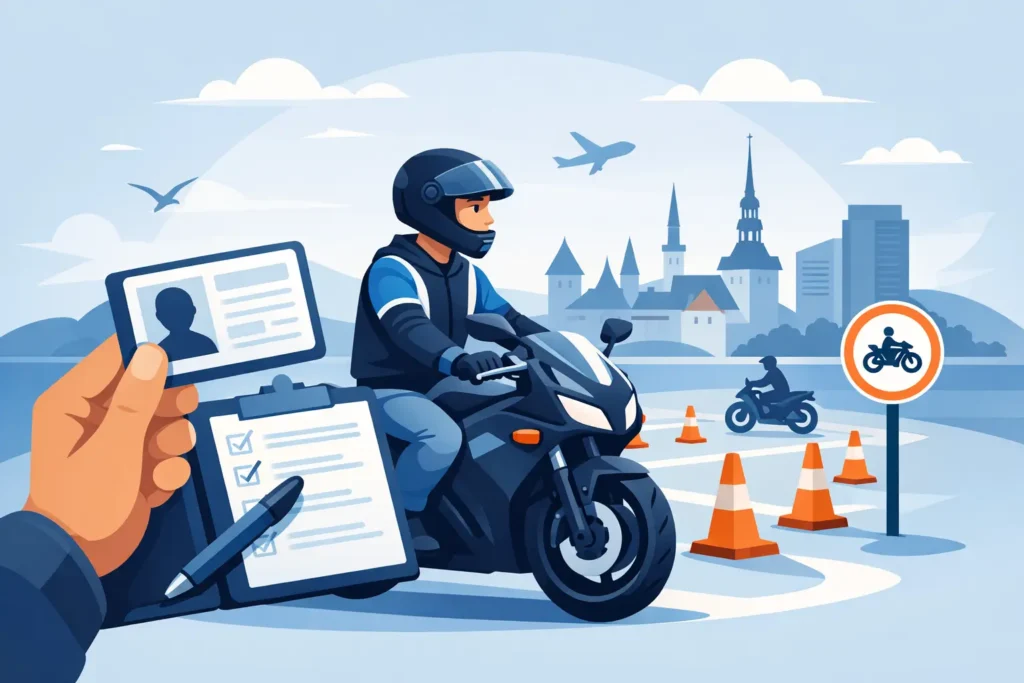
Your first time in the saddle does not have to start with fear or confusion. A motorcycle licence for a beginner in Tallinn means, above all, learning to ride step by step: first you understand how the bike responds, then you practise in a controlled environment, and only then do you bring those skills into real city traffic. The goal is not simply to complete the exercises on exam day, but to feel genuinely secure in traffic once you hold your licence.

Choose the category that suits your age and your bike

A motorcycle licence is not a single category. The right choice depends on your age, your previous riding experience, and the power and engine size of the bike you want to ride later.

Category A1 is intended for lighter motorcycles and can be applied for from the age of 16. Category A2 suits motorcycles up to 35 kW and is generally available from the age of 18. Full category A entitles you to ride motorcycles without restriction. The usual age limit for it is 24, but with category A2 experience you can reach category A earlier.

If you are a complete beginner, do not choose a category purely on the basis of which bike looks most exciting. It makes more sense to think about where and how you will actually ride. In the city and on shorter everyday journeys, a lighter and more manageable bike will give you more confidence than an over-powered machine. If your goal is a larger motorcycle or longer trips on the open road, look at the requirements for category A and at what your age allows.

Always check the current conditions for the categories and the health requirements before registering for a course. That way you start in the right order and do not discover later that the training you chose does not match your plan.

A beginner’s motorcycle licence starts with the theory

Theory is not merely memorising road signs. A motorcyclist has to read traffic with particular care, because they are smaller and less noticeable to everyone else. Many dangerous situations arise at junctions, during lane changes or on left turns – precisely when a car driver fails to notice an approaching motorcycle in time.

So in the theory you learn to judge distances, speeds and visibility. You also come to understand why a wet road surface, tram rails, road markings, gravel or autumn leaves can change a motorcycle’s grip so quickly. In a car a small irregularity may go almost unnoticed; on two wheels it directly affects your balance and your braking distance.

E-learning suits someone whose working or school days are full. You can study at your own pace, but the theory is most useful when you tie it straight to practical riding. If you have just studied braking distance or blind spots, ask your instructor in the next lesson what that looks like in real traffic. The knowledge sticks far better that way.

The first lessons: control before speed

A beginner’s biggest worry is usually balance. In fact nobody expects you to arrive at your first lesson as a finished rider. Teaching normally starts very calmly: getting to know the motorcycle, the correct riding position, coordinating the clutch and the throttle, and moving at low speed.

The exercises on the training area may seem simple at first, but they are the foundation of everything that follows. Riding slowly teaches you to look where you want to go, rather than at the obstacle in front of you. Braking exercises help you feel the role of the front and rear brakes. Turns, slalom and avoidance manoeuvres develop your balance and the coordination of hand, eye and body.

Do not compare yourself with a fellow learner who has ridden a scooter before or has more traffic experience. Some pick up the feel of the clutch quickly; others need more repetitions. What matters is not the number of lessons, but whether you can perform the exercise calmly, deliberately and ever more smoothly.

Riding in Tallinn teaches you to anticipate

On the training area you learn to control the bike; in the city you learn to anticipate risk. In Tallinn that means paying close attention to tram tracks, bus lanes, dense traffic, multi-lane junctions and frequently changing road conditions. For a motorcyclist, good reactions alone are not enough. Far more valuable is the ability to see a dangerous situation a couple of seconds earlier.

In practical training you work on choosing your position in the lane, keeping a sufficient gap and staying visible. You also learn when not to rely on how you expect others to behave. A car may signal a lane change far too late, or not at all. A safe rider leaves themselves room, watches the wheels and the driver’s movements, and prepares to brake before the situation turns sharp.

Evening and weekend lessons in Tallinn are practical not only for fitting around your schedule. They let you experience different traffic densities. At quieter times you can practise harder manoeuvres calmly; in heavier traffic you learn to keep up with the pace. Both skills are needed in real life.

Gear is not a side issue

Your riding gear has a direct effect on your safety and your concentration. A helmet has to sit securely without pressing. Gloves help you hold the bars steadily and protect your hands in a fall. A jacket, trousers, boots and armour reduce the risk of injury, but they also give you a better sense of your body and shelter from wind and rain.

A beginner does not have to buy the most expensive gear straight away. But do not choose on looks or a discount alone. Always try a helmet on, check the fastening, and move around in the gear. If a boot is too stiff or a glove restricts your fingers, using the clutch and the brake becomes awkward. Comfort supports your attention, especially during a longer lesson.

How to prepare sensibly for the state exam

Preparing should not mean panic in the final days. The best result comes from practising consistently and understanding why a particular mistake happens. If you brake too abruptly, look too close in a turn, or lose your balance at low speed, that is not a character flaw. It is a specific skill that the right repetitions will fix.

Before the exam it is worth doing at least one ride in as close to exam conditions as possible. It helps you notice whether nerves scatter your attention, whether you tend to rush, or whether you hesitate too long before deciding. Your instructor’s feedback is especially valuable at that point if it is specific: what to do differently, when to do it, and how to check the result in the next exercise.

In the theory exam, read the questions all the way through. In the riding exam, do not try to guess what the examiner is thinking. Concentrate on the rules, your observation, smooth control and a safe decision. Sometimes the most mature decision is to wait a second longer, because visibility is not good enough.

If you feel fear or uncertainty at the start

Riding a motorcycle feels far more immediate to many people than driving a car. It is more immediate: balance, weather, road surface and speed are all felt through the body. Anxiety does not mean motorcycling is not for you. Usually it just means you need a clearer structure and calm practice.

Good training does not push a learner into a difficult situation before the basics are in place. If an exercise does not work, it is broken into smaller parts. A problem with a slow turn, for instance, may not lie in the turn itself but in where you are looking, in tense arms, or in uneven clutch control. Once the cause is known, the solution becomes reachable.

In Tallinn, category A training is run by Motokool Kindel Lenks, with an individual approach to every learner. Your first lesson does not have to prove that you are already a bold rider. It has to give you a clear next step.

Ask the right questions before starting a course

When choosing a course, look beyond the price. Ask when the lessons take place, what bikes you will learn on, how the theory is organised, and whether extra lessons are available if you need them. For a beginner it also matters whether the instructor explains mistakes clearly and leaves enough time to correct them.

The fastest route to a licence is not always the shortest one in the calendar. If your work schedule is tight, a flexible evening or weekend lesson may be worth more than a cheaper course at times that do not suit you. If you have ridden before, progress may come faster. If you are starting from zero, give yourself permission to learn at your own pace.

Becoming a motorcyclist starts with your first calm pull-away, not your first fast ride. Once you learn to look far ahead, brake deliberately and leave yourself room in traffic, the licence is simply one natural step on the way to becoming a skilled and confident rider.

Seven simple steps to your driving licence

Seven steps to a driving licence

How does training work at Autokool Kindel Rool in Tallinn?

1. First step – signing up
Get in touch with Autokool Kindel Rool. Call 55 44 007, write to us on Messenger, or fill in the form on our website. Based in Tallinn, Autokool Kindel Rool exists to help you obtain your category B licence quickly and effectively.

2. Trial lesson – free and with no commitment
The trial lesson lets you get to know our school and our training cars and try driving with no obligation. In the trial lesson we:

  • introduce you to how the driving training works,
  • go through the basics of how the car is built,
  • practise setting up the driving position and pulling away.

📍 Lessons take place in the evenings and at weekends at the Kadaka Selver training ground.
📊 According to research, 47.1% of learners change driving instructor during their training (J. Koor, 2024). Our aim is to give you a quality training process from beginning to end.

3. Signing the training contract
If you are happy, we sign a training contract setting out the price and the payment terms. Payment in instalments is possible.

4. Theory through e-learning on Liikluslab.ee
In the modern Liikluslab.ee e-learning environment you can study the basics of traffic at your own pace. Three key topics are covered over Zoom. The course ends with the driving school’s theory exam and the Transport Administration theory exam. First aid training is included in the theory course.

5. Driving lessons in Tallinn
Practical lessons start once 75% of the theory is complete. There are 30 driving lessons in total, including night driving and the slippery-road session. Lessons start from the Kadaka Selver car park.

6. Practical exam at the driving school
The practical exam lasts 60 minutes and is conducted in the same way as the Transport Administration exam.

7. The Transport Administration exam and your licence
Once you pass, you hold category B driving entitlement.

Kindel Rool – drive smart, drive with confidence!
A Tallinn driving school that helps you make your licence a reality.

Driving school curricula

Here you can download the category B, A, A1 and A2 curricula in PDF format. The documents are issued in Estonian, as required for official curricula. For details about the courses themselves, see:

Category B curriculum

Category B curriculum (PDF)

A description of the driving and theory volumes, the aims and the learning outcomes.

Category A curriculum

Category A curriculum (PDF)

Manoeuvring area and road training topics, safety skills, and the requirements for completing the course.

Category A2 curricula

A2 initial training curriculum (PDF)

Initial training for category A2: topics, volumes and aims.

A2 further training curriculum (PDF)

Further training for category A2: requirements and learning outcomes.

Category A1 curricula

A1 initial training curriculum (PDF)

Initial training for category A1: topics and learning outcomes.

A1 further training curriculum (PDF)

Further training for category A1.

Kas automaadiga saab manuaali juhtida ohutult?

Can You Drive a Manual With an Automatic Licence?

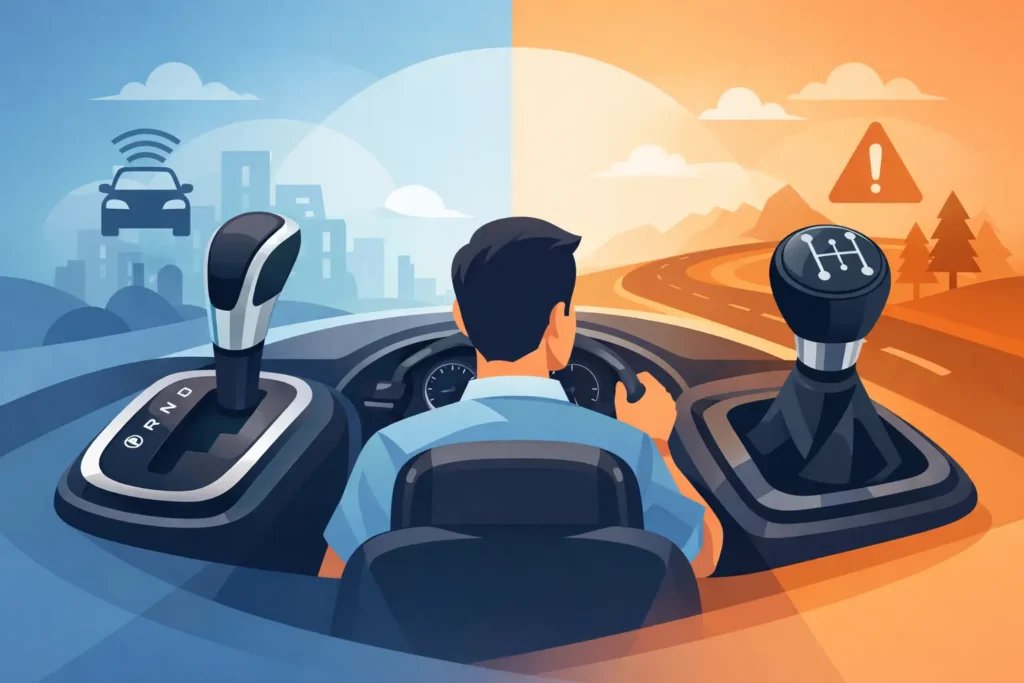
If you learned on an automatic, getting behind the wheel of a manual can seem simple at first: the signs, the mirrors and the rules are all the same. Yet the question “can you drive a manual with an automatic licence?” has two answers. Technically, a manual requires a separate skill. Legally, it depends on which code is on your licence.

The choice between a manual and an automatic does not only decide how you change gear in a lesson. It also affects which cars you are allowed to drive once you have your licence. The right choice depends on your goal, your everyday needs, and the pace at which you want to learn.

Can you drive a manual if you already hold a licence?

If the category B driving test was taken in a car with an automatic gearbox, restriction code 78 is usually added to the licence. That means the entitlement applies to vehicles with an automatic gearbox. You may not drive a manual car in traffic with such a licence, even if you know in theory where the clutch and the gear lever are.

The restriction is not a punishment or a judgement on your driving. It simply shows which gearbox your skill was demonstrated on at the state exam. A driver who passed on an automatic may be very attentive, safe and confident in traffic. Driving a manual, however, adds one separate task: controlling the clutch, the gear and the engine’s torque.

The situation is reversed if you take the category B test in a manual car. In that case no automatic restriction is added, and you may drive both manual and automatic cars. That is why some learners choose a manual precisely for the widest possible freedom of choice.

Why knowing how to drive an automatic is not enough on its own

In an automatic, the car selects the gear itself. More of the driver’s attention is left for watching the traffic, regulating speed, keeping a distance and steering smoothly. For many beginners that is a real advantage, especially in dense Tallinn traffic or when they arrive at a lesson after a long working day.

A manual adds the work of the left foot on the clutch pedal. Pulling away, you have to find the biting point, give a suitable amount of accelerator and release the clutch in a controlled way. Until these actions have become habit, the car may stall, jerk, or roll back too quickly on a slope.

Changing gear also calls for anticipation. Before a turn, a roundabout, a hill or slowing down, you have to select the right gear. For an experienced driver this happens almost automatically; for a beginner it takes conscious attention. That is exactly why an automatic-only entitlement should not be treated as permission to try a manual on your own in traffic.

At the same time, someone who learned on an automatic has no reason to fear a manual. Reading traffic, where to direct your gaze, using the mirrors, keeping a safe side gap and deciding calmly all carry over from one car to another. What has to be learned is mainly the technical handling of the car, not traffic from scratch.

How to remove the automatic restriction from your licence

If you hold a category B licence obtained on an automatic and later want to drive a manual, you have to demonstrate your skill in a manual car. In practice that means at least two additional driving lessons in a manual car at our school and taking a new practical driving exam at the Transport Administration. There is no need to retake the theory exam. After passing, the automatic restriction can be removed from the licence.

Before registering for the exam, check the current requirements and the documents you need. The rules can change over time, and your earlier training, licence details and the planned exam all have to be filed correctly. A driving school can help judge how much practice you actually need, and prepare you for the situations where manual drivers most often go wrong.

Many automatic drivers do not need a long beginners’ course. If you already cope in traffic, the extra lessons can concentrate on the clutch, gear changes, pulling away and driving on hills. The number of lessons depends on the person. Some pick up the basics quickly; others need more time before gear changes stop taking attention away from the road.

Start calmly, with the basics

Learning a manual should start somewhere with little traffic, where the consequences of a mistake are small. First you practise the seating position, the feel of the pedals and a smooth pull-away. Then come braking, changing down, reversing and parking.

Practising a hill start builds a great deal of confidence. The aim is not to do it as fast as possible, but to understand how the car behaves and to stay in control. Once you have found the biting point and your feet no longer require tense concentration, your attention can return to watching the traffic.

Practise the situations you actually need

With a manual, exercises on an empty area are not enough. In city traffic you have to change gear around traffic lights, crossings, junctions and other road users. On the open road you have to choose a gear to suit the speed and plan an overtake or an acceleration at the right moment.

A good instructor does not only say when to change gear. They explain why one gear is better than another in a particular situation, and how the sound, the speed and the engine’s behaviour give the driver feedback. That is how a lasting skill develops, rather than a memorised sequence of actions.

Should you choose an automatic or a manual from the start?

An automatic is a sensible choice if you want to get your licence with as much focus as possible and without the extra load of the clutch. It also suits you well if you already know that the family car or company car is an automatic and you have no real need for a manual. The share of automatic cars keeps growing, and electric cars have no conventional gear changing at all.

A manual may be the better choice if you want to keep every option open. In future you may need an older rental car, a friend’s car, an employer’s vehicle or a cheaper second-hand model. Learning on a manual takes more practice at the start, but gives you broader entitlements on your licence.

Do not decide simply on which seems harder. Ask yourself which car you will be driving over the next couple of years, how quickly you want to reach your licence, and how much time you can give to lessons. If you have a fear of driving or have failed an exam before, an automatic can help reduce the number of tasks to be handled at once. That does not mean less responsibility – watching the traffic and deciding safely always remain the driver’s job.

Three common questions

Can someone with an automatic licence practise in a manual?

Training drives take place under the conditions set out in law and with the appropriate supervision. You may not drive a manual car in traffic on your own with a restricted licence. The safest way is to practise beside an instructor, where you get a clear instruction and help the moment you need it.

Is the exam significantly harder in a manual?

In both cases the exam assesses safe driving above all. With a manual, handling the car is added, so there may be more tension at the start. With enough practice the clutch and the gear changes become ordinary, and in the exam you can concentrate on what counts most: calm, attentive and anticipatory driving.

How quickly can you move from an automatic to a manual?

There is no single number. If your traffic skills are fresh and your automatic driving is already solid, progress can be quick. If you hold a licence but have little driving experience, it is worth taking more lessons and building the skill calmly. Rushing tends to leave gear changes shaky in exactly the more demanding situations.

Driving a manual is a skill to be learned, not an inborn talent. If your goal is more freedom of choice, start with supervised practice, learn to understand how the car behaves, and give yourself time. Autokool Kindel Rool helps you choose a pace that matches your experience, so that the next step behind the wheel is a confident one – in the exam and in real traffic alike.

Juhiloa taotlemise juhend algajale juhile

How to Get a Driving Licence: A Guide for Beginners

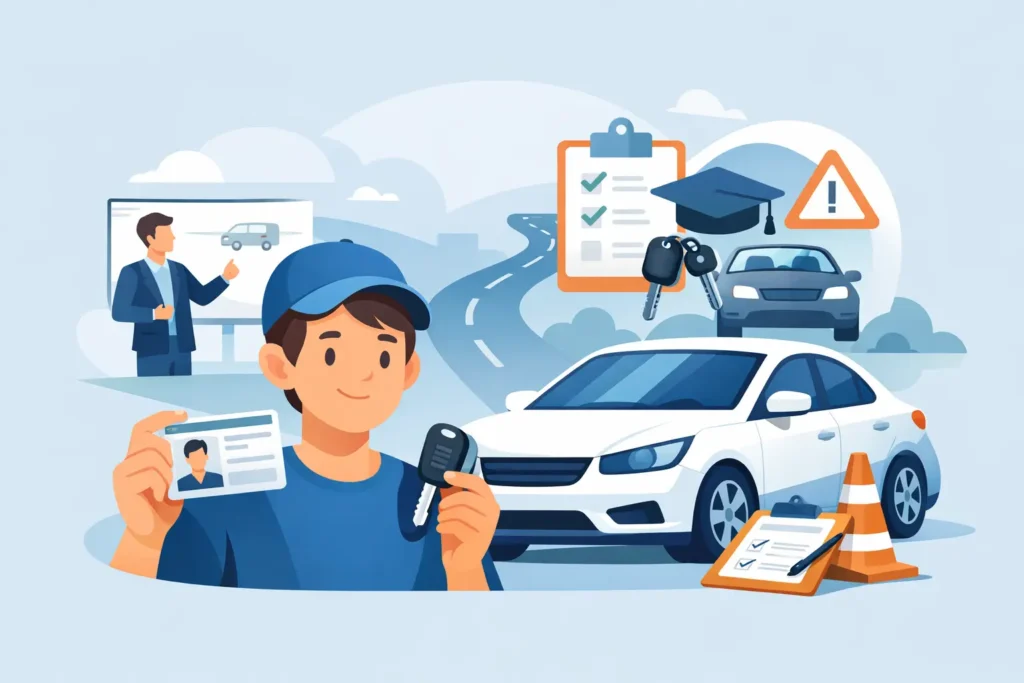
The first driving lesson can feel like a big step, especially if traffic, the clutch or the exam already create tension in advance. A good guide to getting a driving licence does not start on exam day, though, but with a clear plan: you choose a way of learning that suits you, study the rules with understanding, and practise behind the wheel until your decisions become calm and deliberate.

A category B licence is not only a document that gives you freedom of movement. It means responsibility towards other road users, your passengers and yourself. That is why it is worth treating the licence as a skill to be acquired, rather than a checkpoint to be cleared as quickly as possible.

The route to a licence, step by step

Broadly, the path consists of driving school training, the school’s internal assessments, and the state theory and driving exams. The exact requirements, medical certificates and age conditions can change, so check the current terms before you start. A category B licence can usually be obtained once you are of age, but driving training can begin earlier.

The biggest difference between learners does not come from whether someone has sat behind the wheel before. It comes from whether the training is regular and whether feedback is used to set the focus of the next lesson. If you take long breaks, part of the skill has to be recovered each time. If you drive consistently, you start to see the traffic picture as a whole rather than as a sequence of individual signs and manoeuvres.

Choose a driving school whose arrangements fit your life

When choosing a school, look at more than the price of the course. Ask whether the theory can be completed online, whether you can choose between a manual and an automatic, and whether lessons are offered in the evenings and at weekends. For someone in work or study, it is the flexible schedule that most often decides whether the training keeps pace or drags on for months.

The instructor matters just as much. A good teacher does not only say that something went wrong, but explains in which situation the mistake arose, how to notice it earlier, and what decision to make next time. That is especially valuable if you are anxious, have a fear of driving, or a previous exam did not go well. Calm guidance does not mean lowering the standards. It means the demands are clear, well-reasoned and built up in manageable steps.

A free trial lesson helps you judge both the instructor’s way of communicating and whether you feel safe in the car. The point of a first lesson is not to show perfect driving. Its point is to get an honest picture of your starting level and to set out the next steps.

Study the theory through situations, not answers

Theory questions have a correct answer, but in real traffic nobody reads out the options beside you. So in e-learning it is worth tying every topic to a specific situation: who has to give way at this junction, where a pedestrian might come from, what changes in the dark, and when reducing speed alone is not enough.

E-learning suits someone who wants to study at their own pace. It does need a routine, though. It is far more effective to study for shorter periods several times a week than to try to work through all the material in one evening. If a topic keeps coming back with wrong answers, do not simply memorise the answer. Read the explanation and think through which traffic situation lies behind the rule.

Priority, choice of speed, stopping distance, overtaking, visibility and allowing for cyclists and pedestrians deserve particular attention. These are not only exam topics. They are the areas where a driver is expected to anticipate well every single day.

Real driving skill is built in the lessons

In the first lessons you learn to control the car: the correct seating position, using the mirrors, steering, braking, changing gear or the logic of an automatic. Then come reading traffic, junctions, roundabouts, lane changes, parking and roads of different speeds. Skills do not always arrive in the order the textbook sets out. Parking comes quickly to one learner; another is ready for the pace of city traffic sooner. Good training adapts to that.

A manual gives you more flexibility, because such a licence lets you drive both manual and automatic cars. An automatic can be a sensible choice for someone who wants to focus earlier on watching the traffic, or whose everyday car is an automatic. The choice does not make you a better or worse driver. What matters is that the form of training supports your real needs and gives you confidence behind the wheel.

Do not be afraid of mistakes in a lesson. The more dangerous mistake is the one that goes unnoticed and unexamined. Braking too late, for example, may stem from your gaze being on the bonnet rather than further down the road. Uncertainty in a lane change may come from using the mirrors, but not in the right order and without enough time in hand. Once you know the cause, you can practise it.

How to prepare for the exams

Once the theory and driving training at the school are complete and the internal assessments are done, the time for the state exams arrives. The exam does not measure whether you are flawless in every situation. It assesses whether you can cope in traffic safely, independently and within the rules.

When preparing for the theory exam, do practice tests under conditions close to the real thing. Put your phone aside, answer the questions in sequence and keep an eye on the time. If the result is not solid, do not rely on luck. Go through the wrong answers by topic and repeat them until you can explain the rule in your own words.

The driving exam assesses, among other things, observation, choice of speed, lane positioning, consideration for other road users and the independence of your decisions. On exam day you do not have to drive unusually slowly or check every movement twice. Overly cautious driving can equally obstruct traffic and make your intentions unclear. A safe driver is decisive, but never rushed.

A common worry is nerves. They are not removed by being told to calm down. They are reduced by experience. Before the exam, take a lesson in an area with varied traffic, practise the more demanding junctions, and ask your instructor to give as few hints as possible. That way you find out which decisions are already automatic and where you still need conscious attention.

Kindel Rool puts the emphasis on exactly that independence: our category B learners in Tallinn are 1.43 times more likely to pass the driving exam on the first attempt than the Tallinn average. The result does not come from exam tricks, but from consistent practice, clear feedback and the ability to understand your own mistakes before they become habits.

If the exam does not go well the first time

A failed exam does not mean you are unsuited to driving. Often it means one particular skill was not yet stable enough, or that tension affected the result. The worst choice is to take a long break and hope it will go better by itself next time.

Go through the exam feedback as specifically as you can. Was the problem observation, giving way, choice of speed, parking, or a lack of decisiveness? Then plan the extra drives around that weakness. One targeted lesson can achieve more than several drives taken at random.

Further training also suits those for whom a licence has long been the goal, but whose driving school was left unfinished or whose fear of driving has grown. Continuing is not starting from zero. It is putting existing knowledge in order and restoring confidence.

Plan your time and documents early

Getting a licence goes most smoothly when you set a realistic rhythm early on. Account for studying the theory, the driving lessons, the required courses, health requirements and exam dates. If you need the licence by a particular deadline – because of a new job, studies or family needs – build some slack into the plan. Exam slots and the need for extra practice do not always fit the first schedule.

Treat every lesson as a chance to learn something measurable. Before the lesson, think about what you want to improve; afterwards, note briefly what went better and what to repeat next time. That habit makes your progress visible even when a harder manoeuvre does not come off straight away.

Getting a licence is ultimately a route to greater independence, but its value does not end with the exam result. If you learn to anticipate traffic, decide calmly and correct your own mistakes, you will drive well even when there is no examiner beside you.

Scroll to Top