Useful

How to choose your first motorcycle

Please note: motorcycle training is run by Motokool Kindel Lenks. Autokool Kindel Rool teaches category B.

If you think buying your first motorcycle is a decision for life, you are wrong. One of my students spent last year on a city bike, worked out that it was not really his thing, and swapped it for an adventure bike before the summer was over. (Hello, Anton!)

A first bike is a piece of training equipment — do not treat it as the Holy Grail or as a life partner. Your first will not be your last.

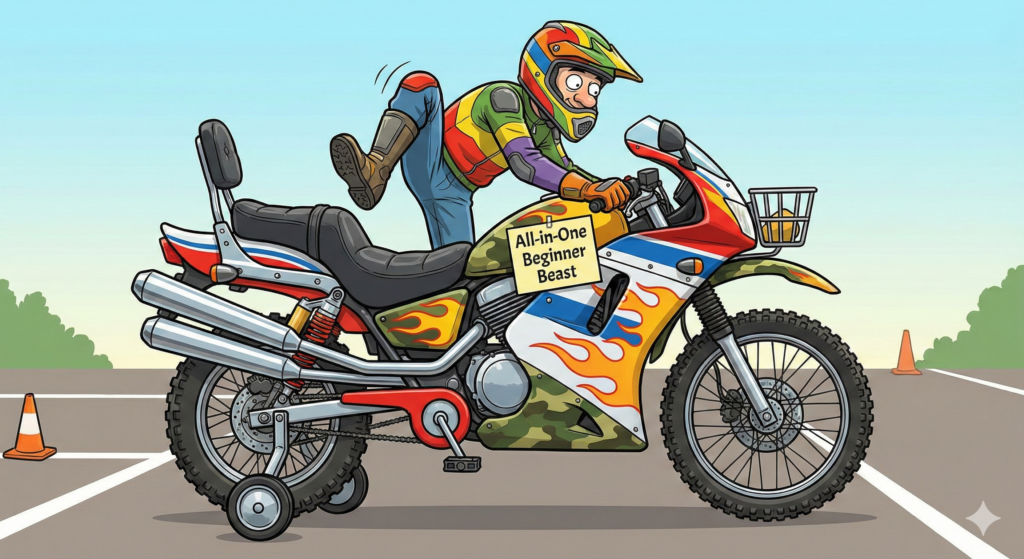
When students ask me which motorcycle to buy first, I always answer: buy the one your heart is set on, the one you actually like. But! There is one “but”.

You see, for me a motorcycle means road dust, fifty shades of mosquito along Lake Peipus and thousands of kilometres a week. So an adventure bike suits me. I cannot recommend it to everyone, though. An adventure is superb, but if your feet do not reach the ground properly, there is a real risk of dropping it on its side at the traffic lights. I did exactly that early in my own riding career — I simply stopped badly at a junction (and yes, teaching people how to stop properly is now exactly what I do).

So do not be afraid to buy a bike that does not make you look like the toughest rider in town from day one. For me a motorcycle is not for Instagram pictures, it is for the soul. First we learn the basics at school, then you ride for a year or two, and only then do you trade up.

Do not be afraid to buy a bike for a single season, get to know yourself on it, and then pass the baton to the next beginner. That is not a marriage of convenience, it is an interesting introduction.

What I recommend when choosing your first bike

  • Stay close to the ground. You need to stand firmly with both feet down. Balancing on tiptoe in a Liivalaia traffic jam is a lottery.
  • Weight matters. A heavy cruiser is beautiful right up until you have to turn it around in a narrow car park. Start with something light and manoeuvrable. And if you do choose a cruiser, do not hesitate to come to the practice ground afterwards — we will work out together how to handle it safely and comfortably.
  • A litre is too much. Modern litre bikes are essentially sports equipment with lights bolted on. A beginner cannot enjoy riding them, because all the effort goes into not flying into the ditch after one accidental movement of the hand. Choose a mid-capacity bike for your first season. And if you still end up with something powerful, come to the practice ground and we will drill the skills you need on your own heavy machine.

My main advice: do not rush into buying a machine before you have started practical training at school. Only when you feel the clutch yourself, the weight of the bike and the way it responds to you on the practice ground will you understand what “character” you actually need. And then go for a test ride, because a motorcycle bought without trying it is foolish.

Remember, too, that buying a motorcycle with your last euro is the worst idea of your life.

Start with the gear

  1. Quality kit. A helmet that is comfortable, and protection you trust.
  2. Set money aside for servicing. There is nothing to add here. If you want to ride without brakes, it is better not to come to my school at all…

What next?

Choosing your first motorcycle is the beginning of a big adventure, and it is better to begin it in the right company. Once the plan is clear, have a look at how preparing for the category A riding test works.

At Motokool Kindel Lenks I do not sell pretty pictures. I teach the technique that keeps you in one piece. Tallinn has its own quirks: tram rails, sudden rain, milled-off asphalt and unpredictable drivers.

If you want to travel the road from a dream to riding with confidence, in a calm and professional atmosphere, let us start together.

Sign up and begin with the theory today, so you can enjoy the riding season in summer: category A training at Motokool Kindel Lenks.

Mandatory direction or one-way street?

In lessons I often see learners mix up “One-way street” (a rectangle) and “Mandatory direction of travel” (a circle). That is completely normal while you are learning – nobody learns without getting it wrong first. Below is a simple rule that makes the difference clear fast.

A round blue sign and a rectangular blue sign with arrows, side by side
Two similar arrows, but different meanings: a circle (an order) versus a rectangle (information about the street).
Mandatory direction sign: a blue circle with a white arrow pointing left
A circle is an order, one single option. From here you MUST go in the direction of the arrow.
One-way street sign: a blue rectangle with a white arrow pointing left
A rectangle is shaped like a road – long and straight. The whole street runs in one direction.

The rule: shape → meaning

CIRCLE = direction, an order
At the junction you MUST travel in the direction of the arrow.

  • Arrow to the right → right turn only
  • Arrow to the left → left turn only
  • Arrow straight ahead → do not turn, drive straight on

RECTANGLE = information about the street
It describes the street – traffic is permitted only in the direction of the arrow (a one-way street). Nobody drives the other way along it.

How to tell them apart in a second

  • Look at the shape first – a circle (an order) or a rectangle (information).

Three common mistakes and what to do about them

  • “A circle always means a turn.” Not necessarily. If the arrow points straight ahead, the order is not to turn but to carry straight on.
  • “A rectangle obliges you to turn.” No. It tells you that this street runs in one direction.
  • “I did not notice the sign at the start of the street or at the junction.” Look at the signs on the side street – if you see a rectangular plate, it is probably a one-way street.

Quick answers

Does a circle with a straight-ahead arrow mean I have to speed up?

No. It means the permitted direction is straight ahead only. Turning off is not allowed.

Where should I position the car on a one-way street when turning left?

At the left-hand edge.

Practise these signs in real situations

We make the signs make sense, rather than something to memorise. Category B courses in Tallinn – the trial lesson is free.

Book a trial lesson Ask on Messenger

Autojuht rooli taga, mõttemull peas – tähelepanu ja otsused, mitte ainult tehnika

Why Driving Is 80% Psychology and Only 20% Technique

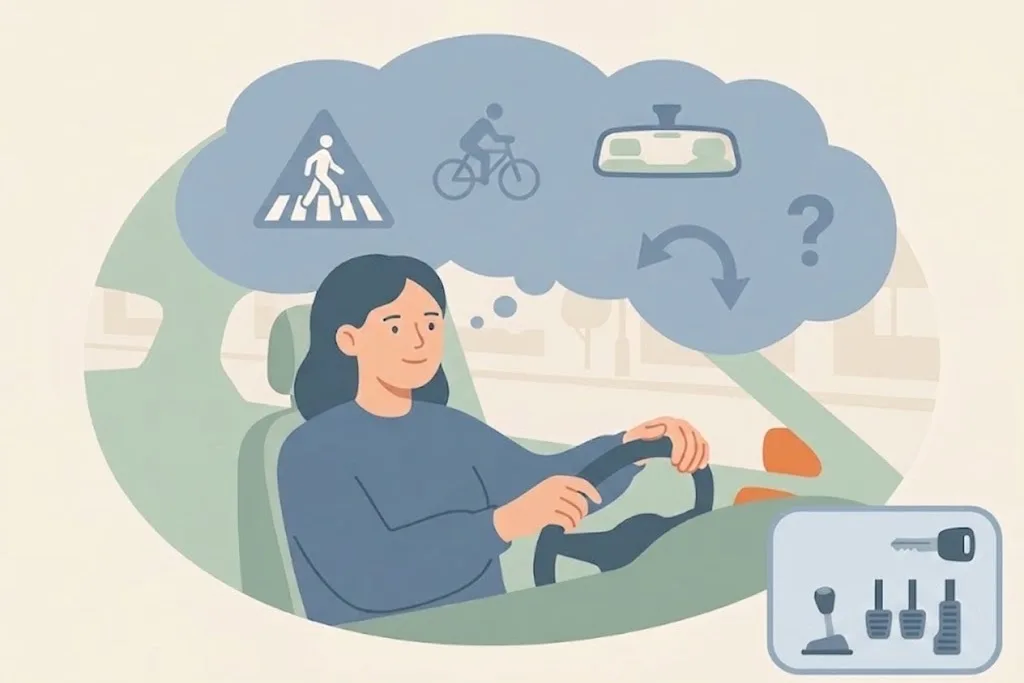
Many people think driving is just a simple sequence of actions: turn the key, select a gear, turn the wheel. Perhaps also memorising what the road signs mean. But in a world of constant change — in Tallinn, restrictions are introduced and lifted, whole streets are rebuilt, tram lines are laid — technical literacy and memorised signs are no longer enough. Today’s traffic is a demanding intellectual environment, where every decision has to rest on your thinking as well as your reflexes.

Responsibility and investment

Anyone starting at a driving school has to recognise what they are taking on: responsibility for their own life, for the lives of the people close to them, and for strangers. I should not be afraid to share the road with that driver afterwards.

Getting a licence must not be treated as a formality: clocking up the compulsory hours and turning up to the exam hoping for the best. It is an investment in your future. The traditional model at many Tallinn driving schools amounts to drilling learners on the exam routes en masse. But that model ignores the most important competence of all — one that is assessed in the exam too: driving independently. Often a learner passes the exam and only then starts “learning” to drive in real life. That approach is dangerous, because it leaves one question unanswered: how does a person behave on the road alone, with no instructor beside them as a safety net?

From instructor to mentor

The goal of genuinely good training is to build habits that let a driver feel confident in any unpredictable situation. This is exactly where the line runs between an ordinary driving instructor and a mentor.

At Autokool Kindel Rool we have introduced a mentoring system for those who value a deliberate approach. Drawing on knowledge gained at Tallinn University’s Haapsalu College, we help learners develop “traffic intelligence” — the ability to notice, analyse and anticipate how events will unfold. We teach people to understand how their emotional state directly affects safety.

The GDE matrix: where safety actually lives

Why do even experienced drivers end up in crashes that could have been avoided? The answer comes from the European training standard — the GDE framework (Goals for Driver Education). This matrix presents driving as a four-storey pyramid:

  • Level I: Vehicle handling. The basics: pedals, gears, manoeuvring.

  • Level II: Driving in traffic situations. Interacting with other road users, following the rules and adapting to the traffic.

Most schools focus on these two levels alone. The craft of the Kindel Rool mentors begins on the “upper floors”, where we teach you to take charge of a situation before it becomes dangerous:

  • Level III: The goals and context of the drive. Why are you behind the wheel? Are you in a hurry? Irritated? Carrying children? This level teaches you to plan a particular journey and assess its risks.

  • Level IV: Personal goals and life skills. The deeper layer of values and self-control. How you handle impulsiveness in life is directly reflected in the gap you keep to the car ahead in heavy traffic.

How we turn theory into a skill that is yours

To make the training a real investment, we use specific methods:

  1. Deliberate planning. Every lesson starts by consolidating what came before. It is a complete process with a clear plan, not aimless circling around the Transport Administration.

  2. Commentary driving. We ask learners to say their intentions and the risks they notice out loud. This helps the mentor understand the logic behind your decisions and shape the right thinking pattern.

  3. The Clean Language technique. We do not issue blunt commands — we ask. Instead of “Brake!” you will hear: “What can you see ahead, and what would be the best action right now?” We activate your brain rather than merely drilling reflexes. The most reliable experience is the one born in your own mind.

  4. Debrief and reflection. Every lesson ends with self-analysis. Road-safety research points consistently in the same direction: training that focuses on vehicle handling alone does not reduce later crash risk – what does is training that builds hazard perception and an honest sense of your own limits.

The trap of imagined mastery

Almost every second driver considers themselves “better than average”. In psychology this is known as a self-enhancement bias. Beginners overestimate their abilities, while experienced drivers underestimate external risks. Without objective feedback, the brain reads the absence of crashes as proof of skill — when often it is simply luck.

Training with us helps to recalibrate your perception. A good driver is not the one who recovers brilliantly from a skid, but the one with the sense not to end up in one.

Driving as a life skill

The road is the most honest test of maturity there is. It reveals your real habits and your level of emotional intelligence. Someone who keeps a clear head in heavy traffic will handle a crisis more effectively in any other area of life.

By choosing mentoring over being drilled for the exam, you learn to take charge not only of the car, but of yourself.

Start your deliberate journey

The best way to understand the difference is to try it for yourself. We invite you to a free trial lesson at Autokool Kindel Rool.

In the lesson you can:

  • Meet our mentors.

  • See the GDE method in practice.

  • Ask any questions you have about the training.

That first meeting will show you what we mean: training with us is not merely a route to a licence, but a route to a calm and safe future.

Book your trial lesson today and feel what a steady wheel in your hands really means.

Kuidas valida autokooli Tallinnas? 7 olulist asja, mida enne registreerumist teada

How to choose a driving school in Tallinn: 7 things to know before you sign up

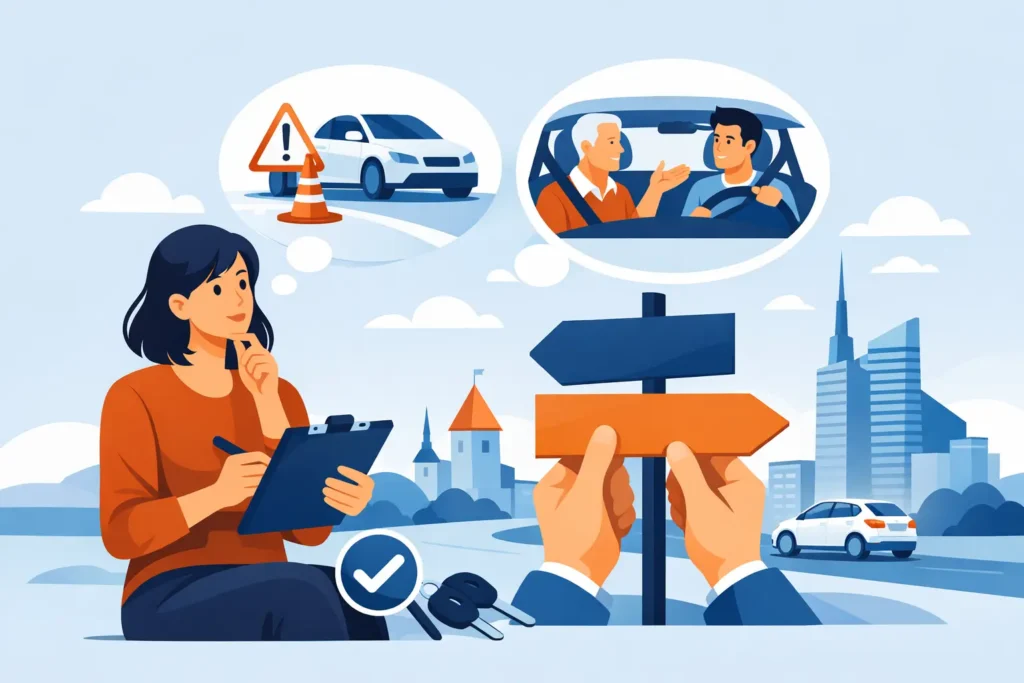
Choosing a driving school in Tallinn is not only a decision about price. You are choosing the person who will sit beside you at your first difficult junctions, teach you to spot a hazard before braking becomes necessary, and help you stay calm on exam day. If you are working out how to choose a driving school in Tallinn, look past the first discount: a good school leaves you able to handle traffic on your own long after the licence is in your pocket.

Tallinn traffic is a varied classroom. The pace of the city centre, trams, public transport lanes, complicated roundabouts, rush-hour queues and winter road conditions ask for more than a memorised exam route. So the choice of school should follow your goal, your schedule and the kind of support you genuinely need while learning.

How to choose a driving school in Tallinn: start with the instructor

The curriculum may be sound and the training car new, but your progress depends largely on the instructor. A good one does not stop at telling you when to turn. They explain why the situation arose, what to notice earlier next time, and how to carry out the decision safely.

Making mistakes in the first lessons is normal. One learner needs longer to feel the clutch, another gets lost in the order of looking at a junction, a third tenses up in heavy traffic. A professional instructor does not turn a mistake into something shameful — they use it as the lesson. Calm, specific, consistent feedback builds confidence far faster than a bare “check your mirror”.

Before signing up, ask how the school handles the fit between learner and instructor. Can you take a free trial lesson? Can you change instructor if it does not work out? Does the feedback come with a clear plan of what to practise next? These questions matter most if you are anxious about driving, had a bad experience before, or have failed the exam more than once.

Compare the total cost, not the headline price

The cheapest advertised course is not always the cheapest in the end. The total usually comes together from the theory course, the compulsory driving lessons, any extra lessons, night-driving and skid-pad training, the medical certificate, state fees and the use of an exam car. Terms differ between schools, so ask for the price list as a whole.

What matters is not only the number of lessons but what they achieve. If teaching is patchy, feedback is vague and the driving happens only on easy streets, more extra lessons will be needed later. That does not make an extra lesson a bad sign — often a few targeted lessons are the most sensible way to close the gaps before the exam. The question is whether the school can explain what those lessons are for and what you will get out of them.

Ask the school to set out plainly what the course price covers and which costs may be added. A transparent answer builds trust. Vague promises along the lines of “we’ll see when we get there” are a reason to be careful.

Ask separately what happens if you have to move a lesson you have already booked. Work schedules change, a child falls ill, a trip comes up — that is ordinary life, not an exception. Find out how far in advance a lesson can be cancelled free of charge, and what happens if you give shorter notice. At Kindel Rool a lesson can be cancelled free of charge 24 hours ahead. If you fall ill later than that, we do not charge for the lesson — illness cannot be planned. Clear cancellation terms are as much a part of the total cost as the price of a single lesson.

Check that the schedule fits your actual life

A licence should not be left unfinished simply because lessons are only offered during working hours or the theory does not fit around your studies. Living in Tallinn, flexibility is decisive for many: workdays run long, evenings belong to the family, and the weekend is the only realistic window for practice.

Online theory lets you work at your own pace, but that should not mean being left alone with your questions. Good organisation combines independent study, clear materials and the chance to get an answer when a rule or a traffic situation stays unclear. The Liikluslabi environment suits someone who wants to take the theory flexibly and revisit the harder topics at a time that works for them.

Ask how booking driving lessons works, too. Can you plan slots with enough notice? Are evening and weekend times genuinely available, or available in theory only? Is the starting point somewhere you can reach easily? Consistency counts: if the next lesson is weeks away, part of it goes on remembering what you had already learned.

Manual or automatic: choose by your own need

The transmission is a practical decision, not a matter of prestige. Learning on an automatic frees up attention for watching traffic, choosing your speed, looking properly and dealing safely with other road users. It suits someone whose future car is an automatic, or who wants fewer things to manage at once while starting out.

A manual, on the other hand, gives you more freedom if you expect to drive different cars. The start is technically harder, because the clutch, gear changes and pulling away smoothly all take practice. Neither choice is more “correct”. Think about the car you will actually drive, how often you will drive it, and which way of learning keeps your attention on the road.

It is worth asking which cars the school teaches on and whether the transmission can be changed if needed. A modern, well-maintained car helps, but it matters more that the instructor teaches you to feel the car rather than simply follow instructions.

Work out what the exam results actually show

Exam statistics are useful because they hint at how consistent the training is. A high first-attempt pass rate can mean learners reach the exam at the right time and properly prepared. But a number on its own does not tell the whole story.

Ask which period and which category the figure covers. Does it concern B-category learners in Tallinn? Is the school talking about first attempts or all attempts? Is the result explained in a comparable context? An honest school does not use statistics as a slogan but connects them to the quality of the teaching, the learner’s readiness and real traffic skill.

Preparing for the exam should not come down to memorising particular streets. The state exam looks at whether a candidate can gather information, justify decisions, choose a speed and take others into account. Those same skills are what get you through a rainy November evening, an unexpected pedestrian or an unfamiliar roundabout.

Notice how the school handles anxiety and weak spots

Some learners make quick progress from the first lessons. For others the licence has been postponed for years, because a previous instructor was impatient or a failed exam shook their confidence. Both deserve a clear plan rather than a comparison with somebody else’s pace.

An individual approach means the instructor notices patterns. If parking goes well but the habit of looking disappears before a left turn, that is what needs practice. If exam nerves make someone rush, exam-like drives help — with each demanding situation calmly talked through afterwards. The aim is not to hide mistakes but to learn to catch and correct them early.

Continued training is a good option for anyone who left a course unfinished, or who wants to rebuild confidence before another exam attempt. Well-planned extra lessons focus on specific needs instead of making you walk the whole road again.

Decide after the trial lesson

A website and a price list give a first impression, but the trial lesson shows most clearly whether the teaching style suits you. Afterwards, ask yourself: did I understand what I did well and what I could change next time? Was the instructor attentive and calm? Did it feel like my goals and my pace mattered to them?

Autokool Kindel Rool offers a free trial lesson in Tallinn and points to the result of its B-category learners there: by the school’s own data they pass on the first attempt about 1.43 times more often than the Tallinn average. That is a meaningful starting point, but what matters most is your own experience behind the wheel: whether the guidance makes the next junction clearer and the next lesson something to look forward to.

A driving licence is an investment in your freedom to move. Choose a school where you can ask, make mistakes and try again without undue pressure, but with clear standards. If the teaching leaves you noticing more and deciding more calmly after every lesson, you are on the right road — not only to the exam, but into real traffic as a confident driver.

When is continued training worth considering?

Continued training is not only for those who failed the exam. It also suits someone who has held a licence for years but has not driven for a long time, is wary of dense Tallinn traffic, or wants to rebuild confidence before driving independently again.

The greatest value of pre-exam lessons is the chance to work on real weaknesses. One learner needs parking, another the choice of speed, a third observation at junctions or coping with exam nerves. A general “let’s do another lap” is not the same as practice with a clear goal and constructive feedback.

How to judge whether you are ready for the exam

Readiness does not mean you will never make another mistake. Even experienced drivers adapt constantly. A learner who is ready can notice a mistake, resolve the situation safely and recover their attention without the whole drive falling apart.

A good sign is being able to choose your speed, notice the signs and plan a lane change before the instructor says anything — and to explain why a decision was safe or why the plan had to change. If the instructor has to prompt every step, more practice is needed, and there is nothing embarrassing about that.

In Tallinn it pays to practise different conditions and times of day. Evening dusk, rain, rush hour and calmer weekend traffic each teach something different. Driving only one familiar route can give false confidence. The more varied the practice, the less your exam depends on whether you happen to get an easy road.

If the exam did not go well, or your lessons have stalled, there is no need to start from zero. A few focused lessons on the difficult topics are often enough: parking, junctions, a feel for speed, observation technique or handling exam pressure.

The express option suits someone who has the basics but needs an outside view and a practice plan. It works best when past attempts are looked at honestly: not “the examiner was harsh” but “at which point did I lose the picture, and how do I prevent that next time?”

Frequently asked questions

How do I choose a driving school if I am very afraid of driving?

Choose a school with a calm teaching style and the option of a free trial lesson. A good instructor does not push from behind but helps release the tension and move forward at a pace that suits you.

What does a free trial lesson mean?

It lets you get to know the instructor, the training car and the school’s way of teaching before you commit to a contract — and check that the two of you get along.

Is a manual or an automatic the better choice?

It depends on your needs. An automatic lets you concentrate on the road and the traffic. A manual gives you the right to drive every B-category car.

Scroll to Top