Category A

How to choose your first motorcycle

Please note: motorcycle training is run by Motokool Kindel Lenks. Autokool Kindel Rool teaches category B.

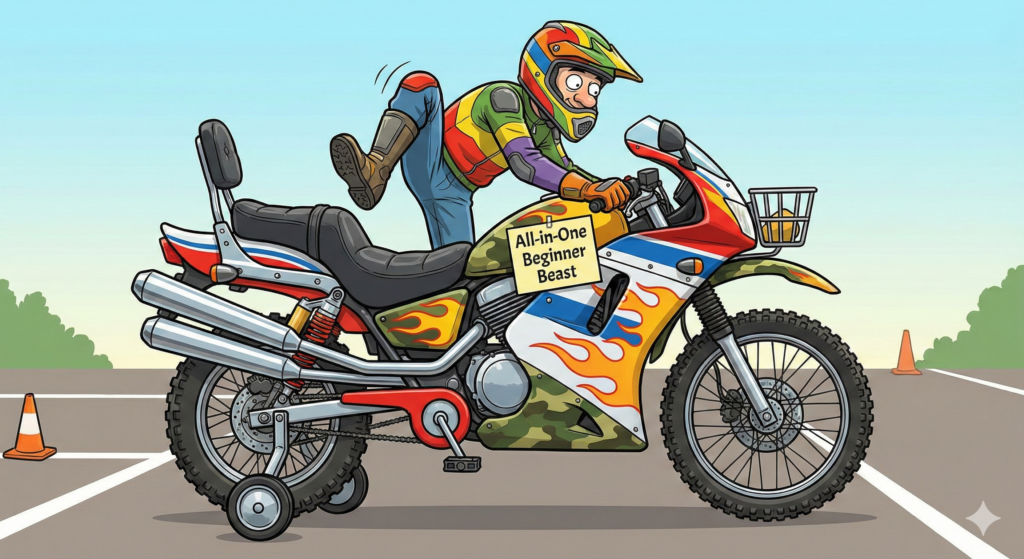
If you think buying your first motorcycle is a decision for life, you are wrong. One of my students spent last year on a city bike, worked out that it was not really his thing, and swapped it for an adventure bike before the summer was over. (Hello, Anton!)
A first bike is a piece of training equipment — do not treat it as the Holy Grail or as a life partner. Your first will not be your last.

When students ask me which motorcycle to buy first, I always answer: buy the one your heart is set on, the one you actually like. But! There is one “but”.

You see, for me a motorcycle means road dust, fifty shades of mosquito along Lake Peipus and thousands of kilometres a week. So an adventure bike suits me. I cannot recommend it to everyone, though. An adventure is superb, but if your feet do not reach the ground properly, there is a real risk of dropping it on its side at the traffic lights. I did exactly that early in my own riding career — I simply stopped badly at a junction (and yes, teaching people how to stop properly is now exactly what I do).

So do not be afraid to buy a bike that does not make you look like the toughest rider in town from day one. For me a motorcycle is not for Instagram pictures, it is for the soul. First we learn the basics at school, then you ride for a year or two, and only then do you trade up.

Do not be afraid to buy a bike for a single season, get to know yourself on it, and then pass the baton to the next beginner. That is not a marriage of convenience, it is an interesting introduction.

What I recommend when choosing your first bike

  • Stay close to the ground. You need to stand firmly with both feet down. Balancing on tiptoe in a Liivalaia traffic jam is a lottery.
  • Weight matters. A heavy cruiser is beautiful right up until you have to turn it around in a narrow car park. Start with something light and manoeuvrable. And if you do choose a cruiser, do not hesitate to come to the practice ground afterwards — we will work out together how to handle it safely and comfortably.
  • A litre is too much. Modern litre bikes are essentially sports equipment with lights bolted on. A beginner cannot enjoy riding them, because all the effort goes into not flying into the ditch after one accidental movement of the hand. Choose a mid-capacity bike for your first season. And if you still end up with something powerful, come to the practice ground and we will drill the skills you need on your own heavy machine.

My main advice: do not rush into buying a machine before you have started practical training at school. Only when you feel the clutch yourself, the weight of the bike and the way it responds to you on the practice ground will you understand what “character” you actually need. And then go for a test ride, because a motorcycle bought without trying it is foolish.

Remember, too, that buying a motorcycle with your last euro is the worst idea of your life.

Start with the gear

  1. Quality kit. A helmet that is comfortable, and protection you trust.
  2. Set money aside for servicing. There is nothing to add here. If you want to ride without brakes, it is better not to come to my school at all…

What next?

Choosing your first motorcycle is the beginning of a big adventure, and it is better to begin it in the right company. Once the plan is clear, have a look at how preparing for the category A riding test works.

At Motokool Kindel Lenks I do not sell pretty pictures. I teach the technique that keeps you in one piece. Tallinn has its own quirks: tram rails, sudden rain, milled-off asphalt and unpredictable drivers.

If you want to travel the road from a dream to riding with confidence, in a calm and professional atmosphere, let us start together.

Sign up and begin with the theory today, so you can enjoy the riding season in summer: category A training at Motokool Kindel Lenks.

A-kategooria sõidueksamiks valmistumine

Preparing for the category A riding test

Please note: motorcycle training is run by Motokool Kindel Lenks. Autokool Kindel Rool teaches category B.

On a motorcycle test it is not enough that the bike starts and the gears go in. Preparing for the category A riding test means being able to keep the machine under control both in a slow exercise on the practice ground and in city traffic, where decisions have to be made quickly but calmly. A good result comes from exercises repeated correctly, not from courage gathered the evening before. If you are still at the very beginning, it helps to see the whole picture first: here is how a motorcycle licence in Tallinn for a beginner works, step by step.
What is actually assessed on the category A riding test

The riding test checks, above all, whether you can handle a motorcycle in traffic independently and safely. The examiner is not looking for a perfect rider, but for someone whose actions are predictable, attentive and safe. A small inaccuracy does not have to end the test — a dangerous decision, insufficient observation or losing control of the bike can.

The test usually consists of exercises on the practice ground and riding in traffic. The exact set-up and requirements change over time, so it is worth checking them with your own instructor before the test — an instructor at Motokool Kindel Lenks knows what is being asked on the practice ground right now. More important than memorising the exercises is understanding why a particular technique is needed: your eyes steer the bike, the clutch and rear brake working together keep you balanced at low speed, and a correct riding position gives stability when braking.

In traffic the same logic is assessed, only more broadly. Do you notice the possible hazards at a junction? Do you choose your speed according to visibility and road conditions? Does your position in the lane give other road users a clear signal? A motorcyclist often has to anticipate other people’s mistakes as well. Knowing the traffic rules alone cannot replace that skill.

Preparing for the category A test starts on the practice ground

Practice-ground exercises feel the most stressful to many learners, because every uncertain movement is felt immediately. In reality the practice ground is the best place to learn the feel of the bike without the extra pressure of city traffic. Once slow riding, turns and braking are under control, more of your attention is free in traffic for observing and deciding.

In slow exercises the biggest mistake is pointing your eyes just in front of the front wheel. Look where you want to go — at the next gate, at the end of the turn, at the free space. The bike follows your eyes far more willingly than a beginner usually expects. Keep your upper body as relaxed as possible, because a stiff grip travels through the handlebars into the movement of the bike.

In faster manoeuvres, choosing the right speed, keeping your eyes up and using smooth control inputs become the decisive things. Accelerate and brake decisively, but not abruptly. A braking exercise does not only measure stopping distance: balance, keeping the bike straight and a controlled stop count just as much.

If an exercise does not work out, do not repeat it dozens of times in the same way. Stop, put the problem into words and change one thing at a time. Did your eyes drop too low? Did the clutch come out too fast? Did you start from the wrong speed? Constructive feedback turns a vague failure into a specific action for the next attempt.

Keep practising after it works

One successful attempt does not yet mean a reliable skill. On the test day nerves, colder asphalt, a different bike or simply more attention on you can all have an effect. A good sign is being able to do the exercise several times in a row and knowing yourself what you are doing at each stage.

At the same time, the goal is not to spend endless hours on the practice ground. Once the basic technique is there, it needs to be kept fresh while the focus moves to traffic. An instructor helps you find that balance: one learner needs more work on slow manoeuvring, another on observation or cornering.

In traffic, riding ahead of the situation is what counts

On a motorcycle, visibility and space are your safety buffer. Keep enough following distance, stay out of blind spots and choose a position in the lane that helps you both see and be seen. This does not mean mechanically following one fixed line. The right position depends on the bend, the road surface, oncoming traffic, parked cars and the weather.

At junctions it pays to think two steps ahead. Before you start a turn or pull out onto a main road, judge not only whether the road is clear right now, but also what other road users intend to do. An indicator is not yet a guarantee that a car will really turn. An oncoming driver may also misjudge a motorcycle’s distance or speed.

On the test, necessary observation is often skipped not out of ignorance but out of haste. Give yourself a clear order of actions: check the mirrors, check the blind spot, signal in good time, choose a suitable speed — and only then change direction. Once that order becomes a habit, you do not have to recall it under pressure on the test.

In Tallinn traffic it is worth practising a range of situations: busier junctions, multi-lane roads, areas around tram tracks, pedestrian crossings and quieter side streets. The aim is not to learn one test route by heart. The aim is to be able to read traffic even when the situation is new.

Gear and knowing your bike add calm

On the day of the test no detail of your gear should come as a surprise. The helmet has to sit firmly, the gloves have to let you feel the levers, and the boots have to give safe footing. New gear that has not been broken in can take your attention even when it is of good quality.

Get to know the bike you are taking to the test as well. Practise its clutch bite point, the sensitivity of the brakes, the turning radius and the riding position. If the training bike differs from what you have ridden before, give yourself time to adapt. Motorcycles within the same category can behave quite differently.

Before you set off, do a calm check: is the gear fastened properly, are the mirrors set and are the controls familiar? This is not a ritual for the examiner — it is a way of taking control before you start moving.

How to make test nerves work for you

Nerves do not mean you are not ready. More often they mean the outcome matters to you. The problem starts when you try to force the nerves down and end up changing your usual rhythm because of it.

On the test day, do not try to ride faster, bolder or more precisely than you did in your lessons. Ride by the same principles you have used again and again: look far ahead, leave yourself space, make decisions early and do not rush. When you are given a riding instruction, listen to it to the end. If it stays unclear, ask again — guessing is a worse choice than a calm clarification.

One small mistake is no reason to panic. If a gear does not go in on the first try, or a stop is not quite as smooth as you wanted, focus on the next action. The examiner assesses the whole ride. Rushing after a slip usually causes more problems than the original mistake.

The last week before the test

In the final week, do not try to fix everything at once. Concentrate on the two or three things you have agreed with your instructor that have the biggest effect on your riding. They might be slow manoeuvring, braking, observation at junctions or smooth lane changes.

Plan your lesson so that there is not too long a gap between the last practice and the test. At the same time, avoid overloading yourself. A tired learner starts making mistakes they would not make when rested. Sleep enough, eat something light before the test and arrive with time to spare.

Good preparation is no promise that everything will go perfectly in every situation. What it does give you is the confidence that you can react calmly when something unexpected happens. Ride smart, ride with control — that is the best attitude both on the test day and on your first ride out alone.

Mootorratta juhiluba Tallinnas algajale sõitjale

A motorcycle licence in Tallinn for a beginner rider

Please note: motorcycle training is run by Motokool Kindel Lenks. Autokool Kindel Rool teaches category B.

Your first time in the saddle does not have to start with fear or confusion. A motorcycle licence for a beginner in Tallinn means, above all, learning to ride step by step: first you understand how the bike responds, then you practise in a controlled environment, and only then do you bring those skills into real city traffic. The goal is not simply to complete the exercises on exam day, but to feel genuinely secure in traffic once you hold your licence.

Choose the category that suits your age and your bike

A motorcycle licence is not a single category. The right choice depends on your age, your previous riding experience, and the power and engine size of the bike you want to ride later.

Category A1 is intended for lighter motorcycles and can be applied for from the age of 16. Category A2 suits motorcycles up to 35 kW and is generally available from the age of 18. Full category A entitles you to ride motorcycles without restriction. The usual age limit for it is 24, but with category A2 experience you can reach category A earlier.

If you are a complete beginner, do not choose a category purely on the basis of which bike looks most exciting. It makes more sense to think about where and how you will actually ride. In the city and on shorter everyday journeys, a lighter and more manageable bike will give you more confidence than an over-powered machine. If your goal is a larger motorcycle or longer trips on the open road, look at the requirements for category A and at what your age allows.

Always check the current conditions for the categories and the health requirements before registering for a course. That way you start in the right order and do not discover later that the training you chose does not match your plan.

A beginner’s motorcycle licence starts with the theory

Theory is not merely memorising road signs. A motorcyclist has to read traffic with particular care, because they are smaller and less noticeable to everyone else. Many dangerous situations arise at junctions, during lane changes or on left turns – precisely when a car driver fails to notice an approaching motorcycle in time.

So in the theory you learn to judge distances, speeds and visibility. You also come to understand why a wet road surface, tram rails, road markings, gravel or autumn leaves can change a motorcycle’s grip so quickly. In a car a small irregularity may go almost unnoticed; on two wheels it directly affects your balance and your braking distance.

E-learning suits someone whose working or school days are full. You can study at your own pace, but the theory is most useful when you tie it straight to practical riding. If you have just studied braking distance or blind spots, ask your instructor in the next lesson what that looks like in real traffic. The knowledge sticks far better that way.

The first lessons: control before speed

A beginner’s biggest worry is usually balance. In fact nobody expects you to arrive at your first lesson as a finished rider. Teaching normally starts very calmly: getting to know the motorcycle, the correct riding position, coordinating the clutch and the throttle, and moving at low speed.

The exercises on the training area may seem simple at first, but they are the foundation of everything that follows. Riding slowly teaches you to look where you want to go, rather than at the obstacle in front of you. Braking exercises help you feel the role of the front and rear brakes. Turns, slalom and avoidance manoeuvres develop your balance and the coordination of hand, eye and body.

Do not compare yourself with a fellow learner who has ridden a scooter before or has more traffic experience. Some pick up the feel of the clutch quickly; others need more repetitions. What matters is not the number of lessons, but whether you can perform the exercise calmly, deliberately and ever more smoothly.

Riding in Tallinn teaches you to anticipate

On the training area you learn to control the bike; in the city you learn to anticipate risk. In Tallinn that means paying close attention to tram tracks, bus lanes, dense traffic, multi-lane junctions and frequently changing road conditions. For a motorcyclist, good reactions alone are not enough. Far more valuable is the ability to see a dangerous situation a couple of seconds earlier.

In practical training you work on choosing your position in the lane, keeping a sufficient gap and staying visible. You also learn when not to rely on how you expect others to behave. A car may signal a lane change far too late, or not at all. A safe rider leaves themselves room, watches the wheels and the driver’s movements, and prepares to brake before the situation turns sharp.

Evening and weekend lessons in Tallinn are practical not only for fitting around your schedule. They let you experience different traffic densities. At quieter times you can practise harder manoeuvres calmly; in heavier traffic you learn to keep up with the pace. Both skills are needed in real life.

Gear is not a side issue

Your riding gear has a direct effect on your safety and your concentration. A helmet has to sit securely without pressing. Gloves help you hold the bars steadily and protect your hands in a fall. A jacket, trousers, boots and armour reduce the risk of injury, but they also give you a better sense of your body and shelter from wind and rain.

A beginner does not have to buy the most expensive gear straight away. But do not choose on looks or a discount alone. Always try a helmet on, check the fastening, and move around in the gear. If a boot is too stiff or a glove restricts your fingers, using the clutch and the brake becomes awkward. Comfort supports your attention, especially during a longer lesson.

How to prepare sensibly for the state exam

Preparing should not mean panic in the final days. The best result comes from practising consistently and understanding why a particular mistake happens. If you brake too abruptly, look too close in a turn, or lose your balance at low speed, that is not a character flaw. It is a specific skill that the right repetitions will fix.

Before the exam it is worth doing at least one ride in as close to exam conditions as possible. It helps you notice whether nerves scatter your attention, whether you tend to rush, or whether you hesitate too long before deciding. Your instructor’s feedback is especially valuable at that point if it is specific: what to do differently, when to do it, and how to check the result in the next exercise.

In the theory exam, read the questions all the way through. In the riding exam, do not try to guess what the examiner is thinking. Concentrate on the rules, your observation, smooth control and a safe decision. Sometimes the most mature decision is to wait a second longer, because visibility is not good enough.

If you feel fear or uncertainty at the start

Riding a motorcycle feels far more immediate to many people than driving a car. It is more immediate: balance, weather, road surface and speed are all felt through the body. Anxiety does not mean motorcycling is not for you. Usually it just means you need a clearer structure and calm practice.

Good training does not push a learner into a difficult situation before the basics are in place. If an exercise does not work, it is broken into smaller parts. A problem with a slow turn, for instance, may not lie in the turn itself but in where you are looking, in tense arms, or in uneven clutch control. Once the cause is known, the solution becomes reachable.

In Tallinn, category A training is run by Motokool Kindel Lenks, with an individual approach to every learner. Your first lesson does not have to prove that you are already a bold rider. It has to give you a clear next step.

Ask the right questions before starting a course

When choosing a course, look beyond the price. Ask when the lessons take place, what bikes you will learn on, how the theory is organised, and whether extra lessons are available if you need them. For a beginner it also matters whether the instructor explains mistakes clearly and leaves enough time to correct them.

The fastest route to a licence is not always the shortest one in the calendar. If your work schedule is tight, a flexible evening or weekend lesson may be worth more than a cheaper course at times that do not suit you. If you have ridden before, progress may come faster. If you are starting from zero, give yourself permission to learn at your own pace.

Becoming a motorcyclist starts with your first calm pull-away, not your first fast ride. Once you learn to look far ahead, brake deliberately and leave yourself room in traffic, the licence is simply one natural step on the way to becoming a skilled and confident rider.

Scroll to Top